


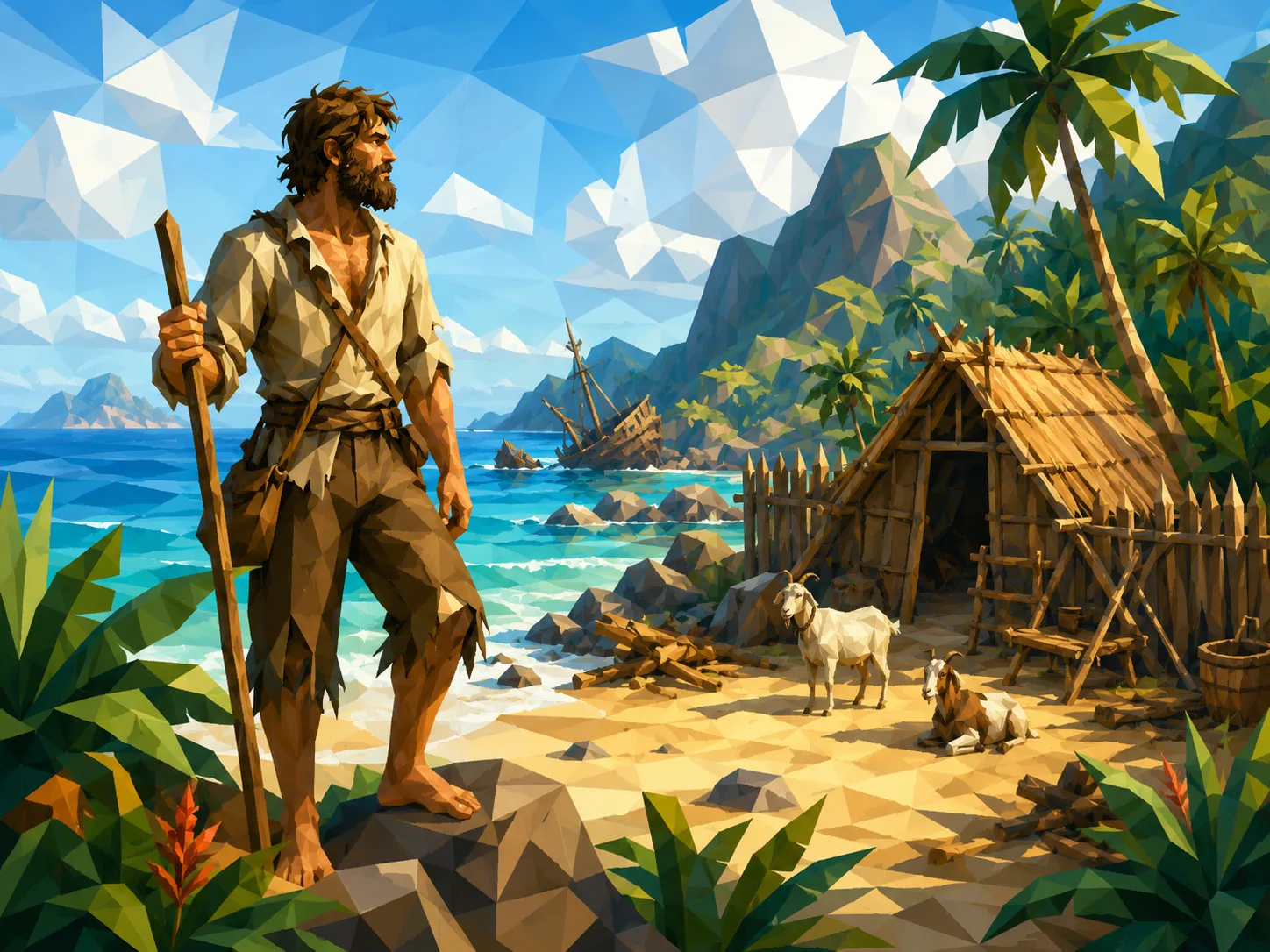
When I awoke, it was broad daylight. The weather was clear and the storm had abated so much that the sea no longer raged as it had before. To my great surprise, I saw that the ship had been lifted from the sandbank during the night by the swelling tide and had been driven nearly as far as the rock where I had been bruised the day before. Since the vessel was now within a mile of the shore and appeared to be standing upright, I desperately wished to be on board so that I might save some necessary items for my survival.
Descending from my apartment in the tree, I surveyed my surroundings. The first thing I discovered was our boat, which had been tossed up onto the land by the wind and waves about two miles to my right. I walked along the shore as far as I could to reach it, but I soon found an inlet of water about half a mile wide blocking my path. I decided to turn back for the time being, as I was more intent on reaching the ship, where I hoped to find something for my immediate subsistence.
A little after noon, the sea became very calm and the tide ebbed so far that I could walk within a quarter of a mile of the ship. Here, I felt a fresh wave of grief; I realized that if we had remained on board, we would all have been safe. Had we stayed, I would not have been left in this miserable, destitute state, entirely deprived of comfort and company. Tears came to my eyes, but knowing that crying would offer no relief, I resolved to get to the ship. I stripped off my clothes—for the heat was extreme—and took to the water.
When I reached the side of the vessel, I found it difficult to get on board. Because she was aground and sitting high out of the water, there was nothing within my reach to grab. I swam around her twice until I spotted a small piece of rope hanging down near the front. With great effort, I managed to catch hold of it and climbed up into the forecastle.
I found that the ship had been damaged and had a great deal of water in her hold. However, she was tilted in such a way that her stern was lifted high onto a bank of hard sand, keeping that section dry. My first priority was to see what provisions were still edible. I found the bread room, filled my pockets with biscuits, and ate them as I went about my work, for I had no time to lose. I also discovered some rum in the main cabin, and I took a large drink to give myself the courage and energy I needed for the task ahead.
Now I lacked only a boat to transport the supplies I knew I would need. It was useless to sit and wish for things I didn't have; this desperate situation forced me to be industrious. We had several spare wooden beams and masts on board. I threw as many of these overboard as I could manage, tying each one with a rope so they wouldn't drift away. I then climbed down the ship’s side, pulled the beams together, and tied four of them at both ends to form a raft. After laying a few planks across them, I found I could walk on it, though it was too light to carry much weight. To improve it, I used a carpenter’s saw to cut a spare mast into three lengths and added them to my raft with a great deal of labour. The hope of furnishing myself with necessities encouraged me to work harder than I ever thought possible.
Once the raft was strong enough, I considered what to load it with. I emptied three large seamen’s chests and lowered them onto the raft. The first I filled with provisions: bread, rice, three Dutch cheeses, and five pieces of dried goat’s meat. I also found a little European corn that had been intended for the ship’s chickens, though the birds themselves had been killed. I discovered later, to my disappointment, that rats had eaten much of the grain. As for liquids, I found several cases of bottles belonging to the captain, containing nearly six gallons of spirits, which I stowed separately on the raft.
While I was doing this, the tide began to flow. I was frustrated to see my coat, shirt, and waistcoat, which I had left on the sand, float away. This prompted me to search the ship for more clothes, but I took only what I needed for the moment. My mind was on more important things: tools. After a long search, I found the carpenter’s chest, which was a more valuable prize to me than a shipload of gold would have been. I lowered it onto the raft immediately.
Next, I looked for weapons. I found two excellent fowling-pieces and two pistols in the cabin, which I secured along with some gunpowder and a small bag of lead shot. I eventually found two dry barrels of gunpowder, though a third had been ruined by water. With these on board, I felt well-supplied. I had no sail or rudder, but the sea was calm, the tide was coming in, and a light breeze was blowing toward the land.
Using two or three broken oars I had found, I began the journey to the shore. For a mile or so, the raft moved well, though I noticed a current pulling me slightly away from my original landing spot. I hoped this meant there was a creek or river nearby that I could use as a port. My suspicions were correct; a small opening in the land appeared.
However, I nearly suffered a second shipwreck. My raft ran aground at one end on a sandbank while the other end remained afloat. My cargo began to slide toward the water. I pressed my back against the chests with all my might to keep them in place. I stood in that position for half an hour until the rising tide finally leveled the raft and I was able to push it off into the channel. Eventually, I found myself in the mouth of a little river.
I spotted a small cove and guided the raft toward it. Because the shore was steep, I had to wait for the tide to reach its highest point so I could float the raft onto a flat piece of ground. When the water finally ebbed away, my raft and all my cargo were left safe on dry land.
My next task was to survey the country and find a proper place to live. I still did not know if I was on a continent or an island, or if I was in danger from wild beasts or savages. I climbed a steep, high hill about a mile away. When I reached the top, I saw my fate with great sadness: I was on an island, surrounded on all sides by the sea. No other land was visible except for some distant rocks and two small islands to the west.
The island appeared barren and uninhabited. I saw many birds but didn't recognize their species, nor did I know which were safe to eat. On my way back, I shot a large bird sitting on a tree. I believe it was the first gun ever fired in that place. At the sound, a massive cloud of birds rose from the woods, screaming in confusion. The bird I killed looked like a hawk, but its flesh was tough and completely useless for food.
I returned to my raft and spent the rest of the day moving my cargo onto the shore. That night, I was afraid to sleep on the ground, so I barricaded myself with the chests and boards to make a small hut.
I realized that I should get as much as possible out of the ship before the first storm broke her into pieces. For the next few days, I made several trips to the vessel. I stripped before each journey, wearing only a shirt and linen drawers. On my second trip, I brought away nails, a grindstone, several hatchets, and seven muskets. I also took the sailors' clothes, a hammock, and some bedding.
During one of my absences, a creature like a wild cat visited my camp. When I returned, she was sitting on one of the chests. She looked at me with great curiosity and didn't seem afraid of my gun. I tossed her a bit of biscuit, which she ate before calmly walking away.
I eventually built a small tent using the ship's sails and poles. I moved everything that might be spoiled by rain or sun into the tent and piled empty chests around it to create a fortification. That night, I slept in a real bed for the first time on the island, with my weapons by my side.
Over the next two weeks, I made eleven trips to the ship. I retrieved rigging, ropes, canvas, and even a large barrel of wet gunpowder. On one trip, I found a hogshead of bread, three containers of rum, a box of sugar, and a barrel of fine flour. I felt as if I were building a massive warehouse.
However, my luck eventually faltered. On one trip, I tried to bring back the heavy ship cables and ironwork on a large, unwieldy raft. It overturned in the cove, and I lost much of the iron. I managed to recover the cables at low tide, but the work was exhausting.
On my final visit, I found a locker with some razors, scissors, and knives. I also discovered about thirty-six pounds in gold and silver coins. I looked at the money and laughed. "O drug!" I said aloud. "What are you good for? You are not even worth picking up. One of these knives is worth more than this entire heap." However, after a moment's thought, I took it anyway.
As I was preparing to leave, the sky darkened and the wind began to blow from the shore. I realized I had to get back before the tide turned, or I might never reach the land. I swam across the channel with great difficulty, struggling against the waves and the weight of the items I had taken. I reached my tent just as a storm began. It blew hard all night, and in the morning, the ship was gone. I was saddened, but comforted by the fact that I had saved almost everything of use.
My thoughts now turned to long-term security. I needed a dwelling that would protect me from both the weather and any potential threats. I decided to move from the low, marshy ground where I had first landed, as it lacked fresh water and was likely unhealthy.
I found a suitable spot on a flat plain at the base of a steep hill. The hill protected me from the back, and there was a small hollow in the rock that looked like the entrance to a cave. I pitched my tent on the grass in front of this hollow. To protect myself, I built a strong fence. I drove two rows of tall, sharpened stakes into the ground and filled the space between them with the heavy ship cables. It was a formidable barrier that neither man nor beast could easily cross. I used a ladder to go over the top, which I pulled up after me when I was inside.
With immense effort, I moved all my provisions and stores into this fortress. I made the tent double—a smaller one inside a larger one—and covered the top with a waterproof tarpaulin. I also began to dig into the rock to create a proper cave, which I used as a cellar for my house.
During this time, a sudden thunderstorm terrified me—not because of the lightning itself, but because I realized my gunpowder was all in one place. One bolt of lightning could destroy everything I needed for food and defense. I spent the next two weeks dividing my 240 pounds of powder into a hundred small parcels and hiding them in different holes among the rocks.
I also discovered that the island was home to wild goats. They were very shy and fast, making them difficult to hunt. However, I observed that their eyes were positioned so that they primarily looked downward. If I climbed the rocks and stayed above them, they didn't notice me. My first shot killed a she-goat, and her young kid followed me all the way back to my enclosure. I tried to tame it, but it wouldn't eat, so I was eventually forced to kill it for meat.
As I sat in my new home, I felt a deep sense of despair. I was hundreds of leagues away from any human trade route. I felt abandoned by Providence. But then, my reason would argue back: "You are alone, it is true, but where are your ten companions? Why were you spared? Is it not better to be alive here than to be at the bottom of the sea?"
I realized how well-equipped I was. What would I have done without a gun, tools, or clothes? I began to keep a calendar by cutting notches into a large wooden post. I arrived on the 30th of September, 1659.
I also found pens, ink, and paper in the captain’s supplies, along with three Bibles and several other books. We had a dog and two cats on the ship; the cats stayed with me, and the dog became my loyal companion for many years. To clear my mind, I wrote down a list of my circumstances in a "debtor and creditor" format:
EVIL
• I am cast upon a horrible, desolate island, without hope of rescue.
• I am separated from all the world to be miserable.
• I have no one to speak to.
GOOD
• I am alive, while the rest of the crew is drowned.
• I have been spared from death, and the power that saved me can deliver me.
• I have enough provisions and tools to survive for a long time.
By focusing on the positive, I began to arrange my life. I enlarged my cave, using the loose rock to create a back door. I also set out to make furniture. Though I had never used tools in my life, I found that through patience and reason, I could master almost any craft. I made a chair and a table from the boards I had saved. To make a single shelf, I had to cut down a whole tree and hew it flat with an axe, a process that took an incredible amount of time. But time was the one thing I had in abundance.
I organized my cave so that every tool and weapon had its place. It gave me great pleasure to see my home so well-ordered. I then began to keep a journal of my daily activities, a record of my silent life on the island, until my ink eventually ran out.