


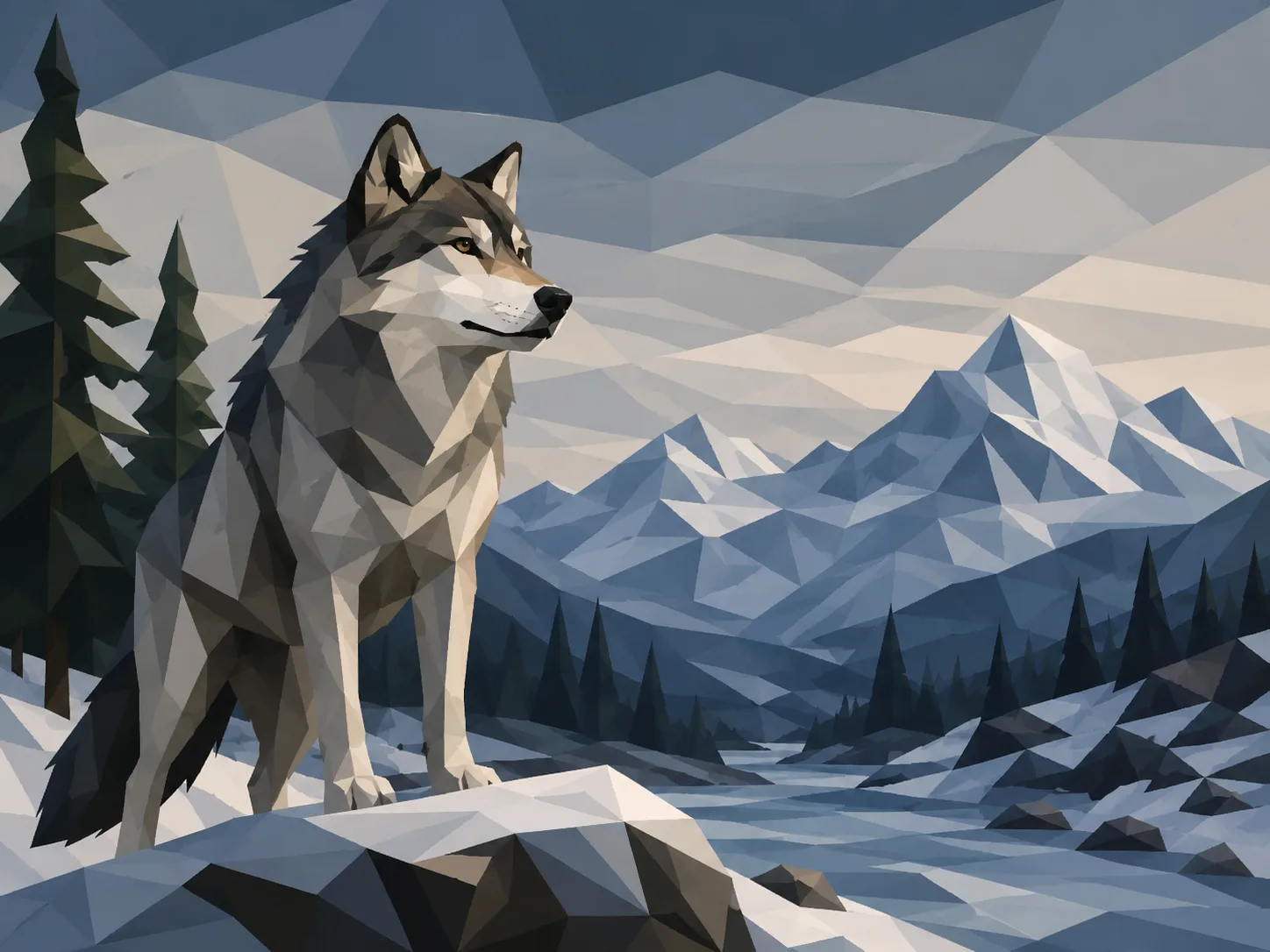
In late December, Grey Beaver began a long journey up the Mackenzie River, accompanied by Mit-sah and Kloo-kooch. They traveled with two sleds. Grey Beaver drove the larger one, while Mit-sah was given a smaller sled pulled by a team of puppies. It was a proud moment for the boy; he was beginning to do a man’s work, learning to train and drive a team. Though it was a smaller operation, the sled was still substantial, carrying nearly two hundred pounds of food and equipment.
White Fang did not particularly resent the harness. He had watched the older dogs toiling in the camp and understood it was part of his new life. His harness consisted of a moss-stuffed collar and a long rope that connected him to the sled. There were seven puppies in the team, and because the snow was soft and powdery, they were arranged in a fan-like formation. Each dog had its own rope of a different length. This clever design ensured that no dog stepped in another’s path and, more importantly, prevented the dogs from attacking one another from behind.
Mit-sah, who possessed much of his father’s "grey wisdom," used this arrangement to settle an old score. He made Lip-lip the leader, which seemed like an honor but was actually a curse. Because Lip-lip was at the end of the longest rope, he was constantly running away from the rest of the pack. To the other dogs, he was no longer a terrifying bully; he was simply a pair of fleeing hind legs. This sight filled them with a desire to hunt him. Whenever Lip-lip tried to turn and defend his dignity, Mit-sah’s thirty-foot whip would sting his face, forcing him to turn back and run. Consequently, Lip-lip spent his days in a state of constant, exhausted flight.
White Fang took to the work with remarkable discipline. Having already surrendered his will to the man-animals, he found it easier to obey than to resist. His life had made him solitary; he didn't need the companionship of other dogs. Kiche was now a fading memory, and his only outlet for expression was his absolute faithfulness to his masters.
While he was an excellent worker, White Fang remained a tyrant among his teammates. He ignored them unless they got in his way or challenged his authority. He lived by a simple, brutal law: oppress the weak and obey the strong. He ate his rations with lightning speed, and woe to any dog who was too slow with their own meal; White Fang would descend upon them with a snarl and finish their portion himself. He maintained a rigid isolation, and any dog that dared to bristle or lift a lip in his presence was swiftly and cruelly punished.
As the months passed, White Fang’s strength grew, but his outlook on life remained bleak and materialistic. To him, the world was a savage place without warmth or affection. He felt no love for Grey Beaver. He respected him as a powerful and intelligent god, but it was a lordship based entirely on fear and strength. Grey Beaver never petted him; he administered justice with a club and rewarded merit only by withholding a blow.
White Fang was naturally suspicious of human hands. In his experience, hands were things that threw stones, swung whips, or pinched and twisted his skin. He was particularly wary of children, whom he found to be unpredictable and cruel. This suspicion eventually led to a significant turning point in his understanding of the law.
In a village near the Great Slave Lake, White Fang was foraging for food when he saw a boy chopping moose-meat. As frozen chips of meat flew into the snow, White Fang began to eat them. The boy immediately attacked him with a heavy club. Cornered against a steep bank, White Fang felt a surge of righteous rage. He had broken no law; the wasted meat belonged to the dog who found it. As the boy moved in to strike, White Fang lunged. In a flash, the boy was knocked into the snow, his hand ripped open by the cub's fangs.
White Fang fled to Grey Beaver, expecting a terrible punishment for the "sacred crime" of biting a god. However, when the boy’s family arrived demanding vengeance, Grey Beaver and his family stood their ground and defended him. Through their angry gestures, White Fang realized a new truth: there were his own gods, and there were "other" gods. He had to accept everything from his own masters, but he was not required to endure injustice from strangers.
Later that day, this lesson was reinforced when Mit-sah was attacked by a group of boys in the forest. White Fang did not hesitate. He leaped into the fight, scattering the bullies and leaving several of them bleeding in the snow. When they returned to camp, Grey Beaver rewarded White Fang with a large portion of meat. The law was now clear: he was the protector of his masters.
This protection soon extended to his masters' property. White Fang became a fierce guardian, learning that a thieving god was usually a cowardly one. He never barked to give an alarm; instead, he would strike silently and dangerously. This made him even more solitary and ferocious, further distancing him from the other dogs.
Thus, the "Covenant" between dog and man was sealed. It was the same ancient agreement the first wolf had made with the first humans. In exchange for his liberty, White Fang received food, fire, and protection. In return, he gave his strength, his loyalty, and his life. He did not know love, but he knew duty. His allegiance to man had become the fundamental law of his existence, a bond stronger than his memory of the Wild or his love of freedom.