


The Science of Everyday Things
Explore why ice melts, shadows grow, and everyday objects behave in surprising ways.
Preview
Questions with solutions-
1. Escolhe a resposta correta.
Why does the ice become liquid?
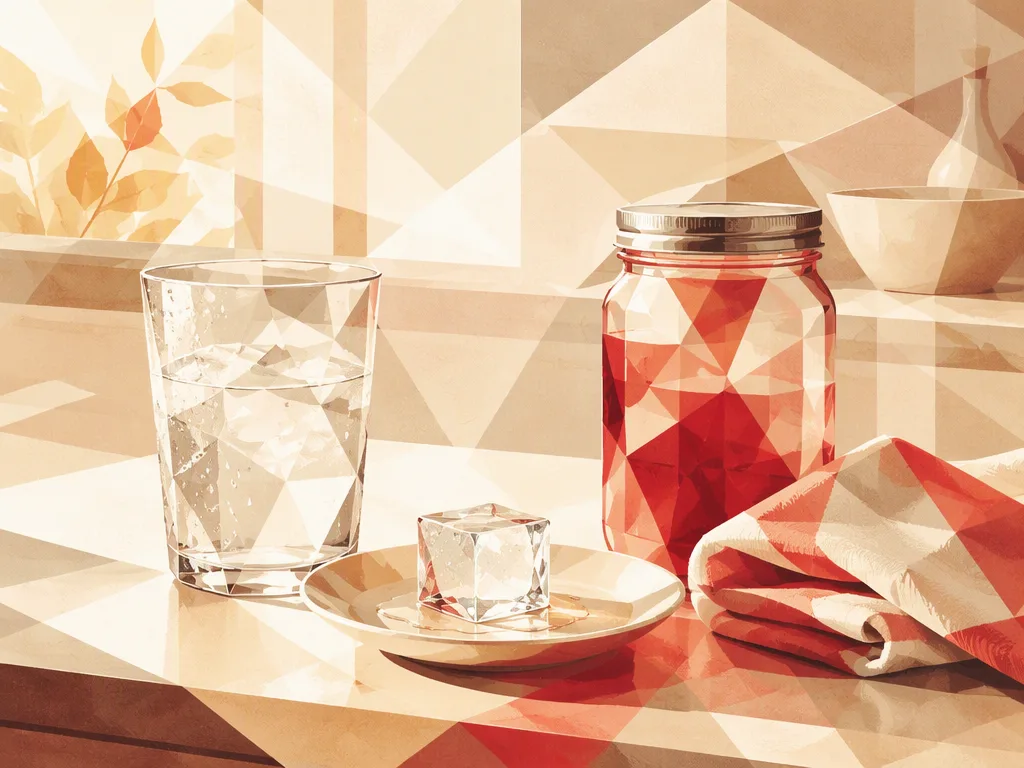
An ice cube is left on a plate in a warm kitchen. Slowly, it melts.
- It absorbs heat from the room.
- It releases heat into the room.
- The room air presses it into a liquid.
Think about which is warmer: the ice or the room.
Show solution
- It absorbs heat from the room.
Heat moves from warmer things to colder things. Even cool room air can be warm enough to melt ice.
-
2. Preenche o espaço em branco.
A ball rolls across a level carpet. It slows down because ___ acts against its movement.
- gravity
- friction
- magnetism
Think about the contact between the ball and the carpet.
Show solution
A ball rolls across a level carpet. It slows down because friction acts against its movement.
Friction resists movement between touching surfaces. Some of the energy from the ball's movement becomes heat.
-
3. Escolhe a resposta correta.
Why can you see your face in the mirror?
You stand in front of a mirror in a bright room.
- It makes its own light in the shape of your face.
- It pulls light from your eyes toward your face.
- It sends light from your face back to your eyes.
A mirror changes the direction of light.
Show solution
- It sends light from your face back to your eyes.
A mirror reflects light. Its smooth surface keeps the reflected light organized, so you see a clear image.
-
4. Escolhe a resposta correta.
What produces the sound?
You pull a guitar string to one side and let it go. You hear a musical note.
- The string heats the air as it moves.
- The string vibrates and makes the air vibrate.
- The string sends light waves through the air.
Watch how the string moves after you let it go.
Show solution
- The string vibrates and makes the air vibrate.
Sound travels through the air as vibrations. The guitar's body also vibrates, making the sound louder.
-
5. Preenche o espaço em branco.
Cooking oil and water are at the same temperature. The oil floats on top because it is ___.
- more dense than water
- as dense as water
- less dense than water
Compare the weight of equal volumes of oil and water.
Show solution
Cooking oil and water are at the same temperature. The oil floats on top because it is less dense than water.
Density compares mass with volume. A cup of cooking oil weighs less than a cup of water.
-
6. Escolhe a resposta correta.
Why is your shadow longer in the late afternoon?
On level ground, your shadow is usually longer in the late afternoon than around noon.
- The Sun is lower in the sky.
- The Sun is higher in the sky.
- The Sun is much closer to Earth.
Think about the angle at which sunlight reaches the ground.
Show solution
- The Sun is lower in the sky.
Light from a low Sun reaches the ground at a smaller angle, stretching shadows farther across it.
-
7. Escolhe a resposta correta.
Where does the water on the outside come from?
A dry, unbroken glass is filled with ice water. Soon, drops form on the outside. No water has spilled.
- Water inside passes through the glass.
- Water in the air cools and becomes liquid.
- The ice pushes water over the top.
Air contains water even when you cannot see it.
Show solution
- Water in the air cools and becomes liquid.
This change is called condensation. It also produces drops on a bathroom mirror after a hot shower.
-
8. Preenche o espaço em branco.
Two shirts are made of the same fabric and have the same thickness. In direct sunlight, the black shirt usually gets hotter because it ___.
- reflects more of the sunlight
- absorbs none of the sunlight
- absorbs more of the sunlight
Think about whether the light bounces away or enters the material.
Show solution
Two shirts are made of the same fabric and have the same thickness. In direct sunlight, the black shirt usually gets hotter because it absorbs more of the sunlight.
Absorbed sunlight adds heat to the fabric. White surfaces reflect more sunlight, which can help them stay cooler.
-
9. Escolhe a resposta correta.
What pulls the hair toward the balloon?
You rub a balloon against a sweater. When you hold it near your hair, some hairs rise toward it.
- An electric force.
- A magnetic force.
- Extra air pressure.
Rubbing can move tiny charged particles between materials.
Show solution
- An electric force.
Rubbing gives the balloon an electric charge. It can also attract small pieces of paper, even though they are not metal.
-
10. Escolhe a resposta correta.
Why does your skin feel cooler as your hands dry?
Your hands are wet. As they dry in the air, your skin feels cool.
- The water gives extra heat to your skin.
- The water becomes tiny pieces of ice.
- The water takes heat from your skin as it becomes a gas.
Changing liquid water into a gas requires energy.
Show solution
- The water takes heat from your skin as it becomes a gas.
This process is called evaporation. Sweat cools your body in the same way when it evaporates.
-
11. Escolhe a resposta correta.
Why can warming the lid make it easier to open?
A metal lid is stuck on a glass jar. You run warm water over the lid.
- The metal lid becomes lighter.
- The metal lid expands a little.
- The metal lid shrinks a little.
Think about how the size of metal changes when it gets warmer.
Show solution
- The metal lid expands a little.
Most metals expand when heated. Even a small increase in the lid's width can loosen its grip on the jar.
-
12. Escolhe a resposta correta.
How does the trapped air help a hot drink stay warm?
A cup has two walls with still air trapped between them.
- The air slows the movement of heat out of the cup.
- The air produces new heat inside the cup.
- The air carries heat quickly through the walls.
Still air does not pass heat along easily.
Show solution
- The air slows the movement of heat out of the cup.
Trapped air provides insulation: it slows heat loss. Many warm jackets also trap air between their fibers.
-
13. Preenche o espaço em branco.
Two backpacks weigh the same, but one has wider shoulder straps. The wider straps can feel more comfortable because they spread the weight over ___.
- a smaller area of your shoulders
- the same area of your shoulders
- a larger area of your shoulders
Compare how a thin string and a wide belt press against your hand.
Show solution
Two backpacks weigh the same, but one has wider shoulder straps. The wider straps can feel more comfortable because they spread the weight over a larger area of your shoulders.
The same force spread over a larger area creates less pressure. Wider straps reduce pressure without reducing the backpack's weight.
-
14. Escolhe a resposta correta.
Why can potatoes take longer to cook in boiling water there?
High in the mountains, water boils at a lower temperature than it does at sea level.
- Water stops transferring heat once it boils.
- The water is cooler, even while it is boiling.
- The bubbles in the boiling water prevent heat from reaching the potatoes.
Boiling water is not always at the same temperature.
Show solution
- The water is cooler, even while it is boiling.
Lower air pressure allows water to boil at a lower temperature. Food can therefore cook more slowly, even with plenty of bubbles.
-
15. Escolhe a resposta correta.
What makes the bottle's sides bend inward?
A thin plastic bottle full of warm air is tightly closed. As it cools in a cold room, its sides bend inward.
- The air inside pushes harder than the air outside.
- The air pressure is equal inside and outside.
- The air outside pushes harder than the air inside.
The bottle is closed, so no more air can enter as the trapped air cools.
Show solution
- The air outside pushes harder than the air inside.
Cooling lowers the pressure of the trapped air. Outside air then pushes the flexible sides inward.