


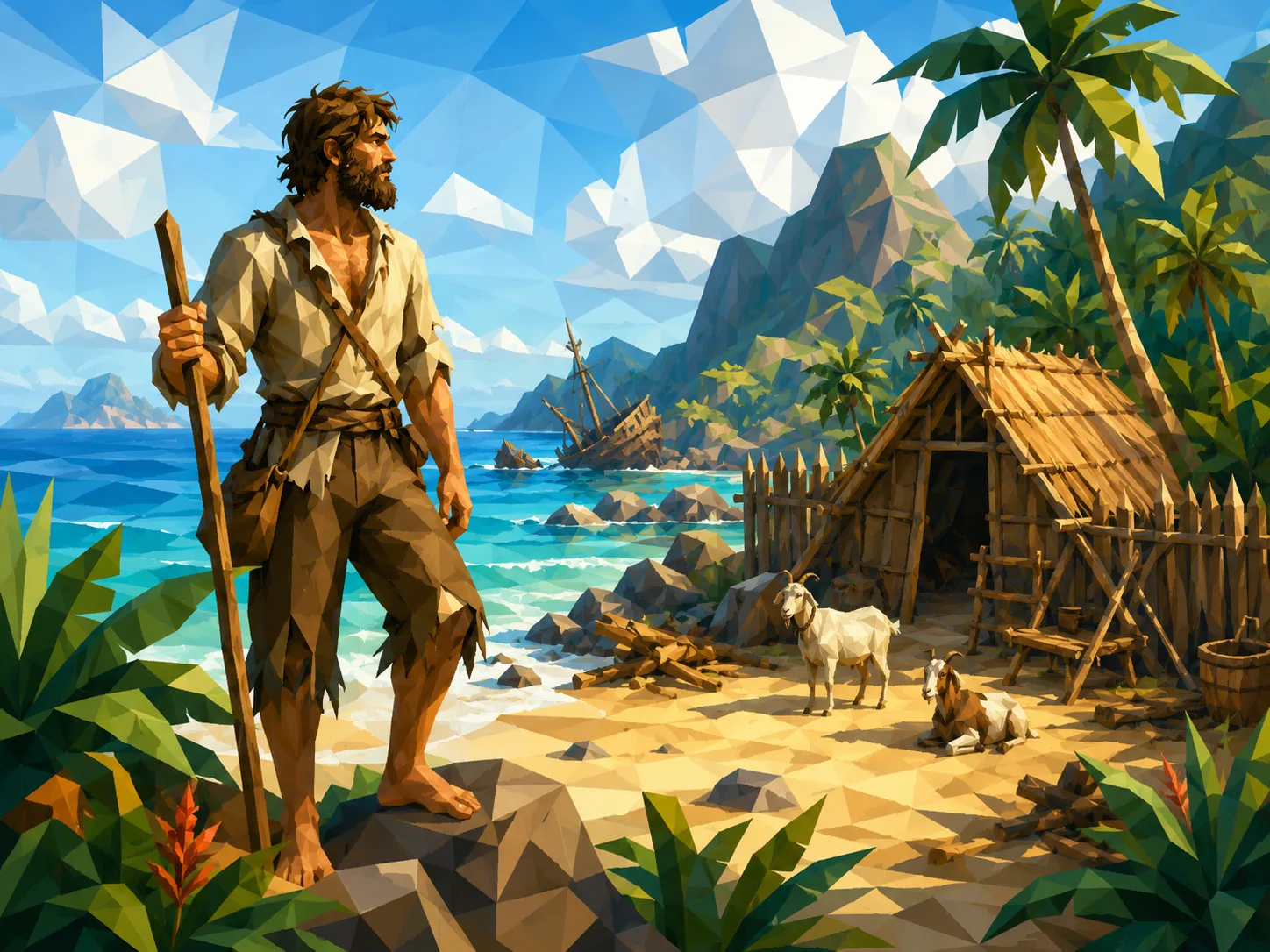
By now, I had been living on this island for twenty-three years. I was so well adjusted to my surroundings and my way of life that, had I been certain no savages would ever come to disturb me, I would have been perfectly happy to spend the rest of my days there. I could have lived out my life until the very end, eventually passing away as peacefully as the old goat I had found in the cave. I had even developed several small diversions and hobbies that made my time pass much more pleasantly than in the beginning.
First, there was my parrot, Poll. As I mentioned before, I had taught him to speak so clearly and familiarly that it was a great joy to listen to him. He lived with me for no less than twenty-six years. I often wondered how much longer he might have lived; I know that in the Brazils, people believe parrots can live for a century. My dog had also been a loyal and loving companion for sixteen years before he finally died of old age. As for my cats, they multiplied so rapidly that I was initially forced to shoot several of them to prevent them from devouring my supplies. Eventually, after the two original cats passed away, I drove the rest into the woods. They lived there as wild animals, except for two or three favorites that I kept as pets.
In addition to these, I always kept a few young goats around me, which I taught to eat directly from my hand. I also had two more parrots that could speak reasonably well and would call out “Robin Crusoe,” though none could compare to my first. I also kept several tame sea-birds that I had caught on the shore. After clipping their wings, I allowed them to live among the grove of trees I had planted near my castle wall. They even began to breed there, which I found very agreeable. Indeed, I was beginning to feel quite content with my solitary existence, provided I could remain safe from the threat of savages.
However, life often takes an unexpected direction. It is a useful observation for anyone reading my story that the very evil we try hardest to avoid often becomes the door to our deliverance. In the final years of my residence on the island, this truth became remarkably clear.
It was December, the time of the southern solstice, which served as my harvest season. This required me to be out in the fields quite often. One morning, before the sun had fully risen, I was startled to see a fire burning on the shore. It was about two miles away, in the part of the island where I had previously seen signs of savages. To my great distress, however, it was now on my side of the island.
Stunned by this sight, I hid within my grove, not daring to step out for fear of being discovered. I felt no peace, for I was terrified that if these savages wandered across the island and found my cultivated corn or my various improvements, they would realize the island was inhabited. They would surely never rest until they had hunted me down. I retreated to my castle, pulled up my ladder, and did everything possible to make my home look like a wild, uninhabited place.
Inside, I prepared for a battle. I loaded all my muskets—which I called my "cannon"—and my pistols, resolving to defend myself to the last breath. I did not forget to pray earnestly, asking for Divine protection from these barbarians. After waiting impatiently for two hours, I could no longer bear the uncertainty. I set up my ladder against the side of the hill, climbed to the top, and lay flat on my belly. Using my telescope, I looked toward the shore.
I soon discovered nine naked savages sitting around a small fire. They had not built it for warmth, as the weather was extremely hot, but presumably to prepare a horrific feast of human flesh. They had two canoes with them, which were hauled up on the sand. Since the tide was low, they seemed to be waiting for the water to return before they departed.
It is difficult to describe the confusion and fear this sight caused me. However, when I realized that they always arrived and departed with the tide, I began to feel more composed. I understood that I could safely go about my work as long as the tide was high. As I expected, as soon as the tide turned, they all boarded their boats and paddled away. Before they left, I watched them through my glass as they danced for over an hour, their naked bodies moving in strange, rhythmic gestures.
As soon as they were gone, I armed myself heavily with two guns, two pistols, and my great sword. I hurried to the spot where they had been, though the weight of my weapons made the journey take nearly two hours. When I arrived, I saw the remains of three more canoes that had been there earlier. Looking out to sea, I could see them all together, heading back toward the mainland. It was a dreadful sight. Down on the shore, I saw the horrific marks of their visit: the blood, the bones, and the remains of human bodies. I was filled with such indignation that I began to plan the destruction of the next group that dared to land on my shore.
For the next fifteen months, I lived in a state of constant anxiety. I was in a "murdering mood," spending my hours plotting how to attack them. I did not stop to consider that killing a dozen of them would only lead to more arriving, eventually making me as much of a murderer as they were. I spent my days in perplexity, looking around with extreme caution whenever I ventured outside. I was thankful that I had my tame flock of goats, for I did not dare to fire my gun, lest I should alert any nearby savages.
In the middle of May, during my twenty-fourth year, a strange event occurred. It had been a day of violent storms, with fierce winds, lightning, and thunder. As I sat in my castle reading the Bible, I was startled by a sound I had not heard for years: the boom of a gun at sea.
I rushed to my ladder and climbed to the top of the hill. A flash of fire in the distance was followed by a second report. I realized immediately that a ship must be in distress. Although I could not help them, I thought that perhaps they could help me. I quickly gathered dry wood and lit a massive bonfire on the hill. The wind was strong, but the fire blazed brightly. In response, I heard several more guns from the same direction.
I kept the fire burning all night. When morning came and the weather cleared, I saw something in the distance. Even with my telescope, I couldn't tell if it was a hull or a sail. However, I noticed it wasn't moving and concluded it was a ship at anchor—or rather, a ship that had run aground.
I hurried to the south side of the island, to the very rocks where I had nearly been swept away years before. There, to my great sorrow, I saw the wreck of a ship. It had been cast away during the night upon the concealed rocks. It was a sobering thought: the same rocks that had almost killed me had caused the destruction of these men.
I felt a profound sense of pity for the crew. I realized once again that no matter how miserable our condition, there is always someone in a worse position for whom we should be thankful. I felt a desperate, overwhelming longing for human company. "Oh, if only one soul had been saved!" I cried out. "Just one person to talk to!" The desire was so intense that my hands clenched involuntarily, and I felt a physical ache in my chest. But it was not meant to be. A few days later, the only sign of life I found was the body of a drowned boy that washed up on the shore. He had nothing in his pockets but two pieces of eight and a tobacco pipe—the latter being far more valuable to me than the money.
When the sea grew calm, I decided to venture out to the wreck in my boat. I hoped I might find something useful, or perhaps even a survivor. I spent hours preparing, loading my canoe with bread, water, rum, raisins, rice, and even an umbrella for shade. I carefully observed the currents, remembering how they had nearly carried me to my death before. By watching the tides, I realized I could use the northern current to reach the ship and the returning tide to bring me home.
The next morning, I set out. The current carried me swiftly, and in less than two hours, I reached the wreck. It was a Spanish ship, jammed firmly between two rocks. The stern had been beaten to pieces by the waves, but the bow remained solid. As I approached, a dog appeared on the deck, yelping piteously. When I called to him, he jumped into the sea. I pulled him into my boat; he was nearly dead from hunger and thirst.
On board, the first thing I saw were two drowned men in the galley, their arms wrapped around each other. They had likely been trapped as the ship was submerged by the storm. Aside from the dog, there was nothing living on the ship.
I spent the day searching the wreck. I found several large chests and managed to get two of them into my boat. I also found a small cask of liquor, some muskets, a powder-horn, and various kitchen utensils like a fire-shovel, tongs, and a copper pot. I returned to the island that evening, exhausted but curious about my find.
The next morning, I examined the contents of the chests. In one, I found bottles of cordial waters, fine shirts, and several linen handkerchiefs, which were incredibly refreshing in the heat. But the most surprising discovery was at the bottom of the chest: three large bags of money, containing about eleven hundred pieces of eight, along with several gold doubloons and small gold bars.
In the second chest, I found more clothes and some fine gunpowder. Despite the wealth I had found, I felt a sense of disappointment. The money was useless to me—nothing more than dirt under my feet. I would have gladly traded all that gold for three or four pairs of English shoes and stockings, which I desperately needed. I did manage to take some shoes from the drowned men and found a few more pairs in the chests, though they were not very sturdy.
I carried the treasure back to my cave and hid it away, just as I had done with the money from my own ship years ago. It was a pity that I couldn't reach the rest of the ship's cargo, for I was certain there was a fortune left behind. "If I ever escape to England," I thought to myself, "this money will be waiting here for me to fetch it."