


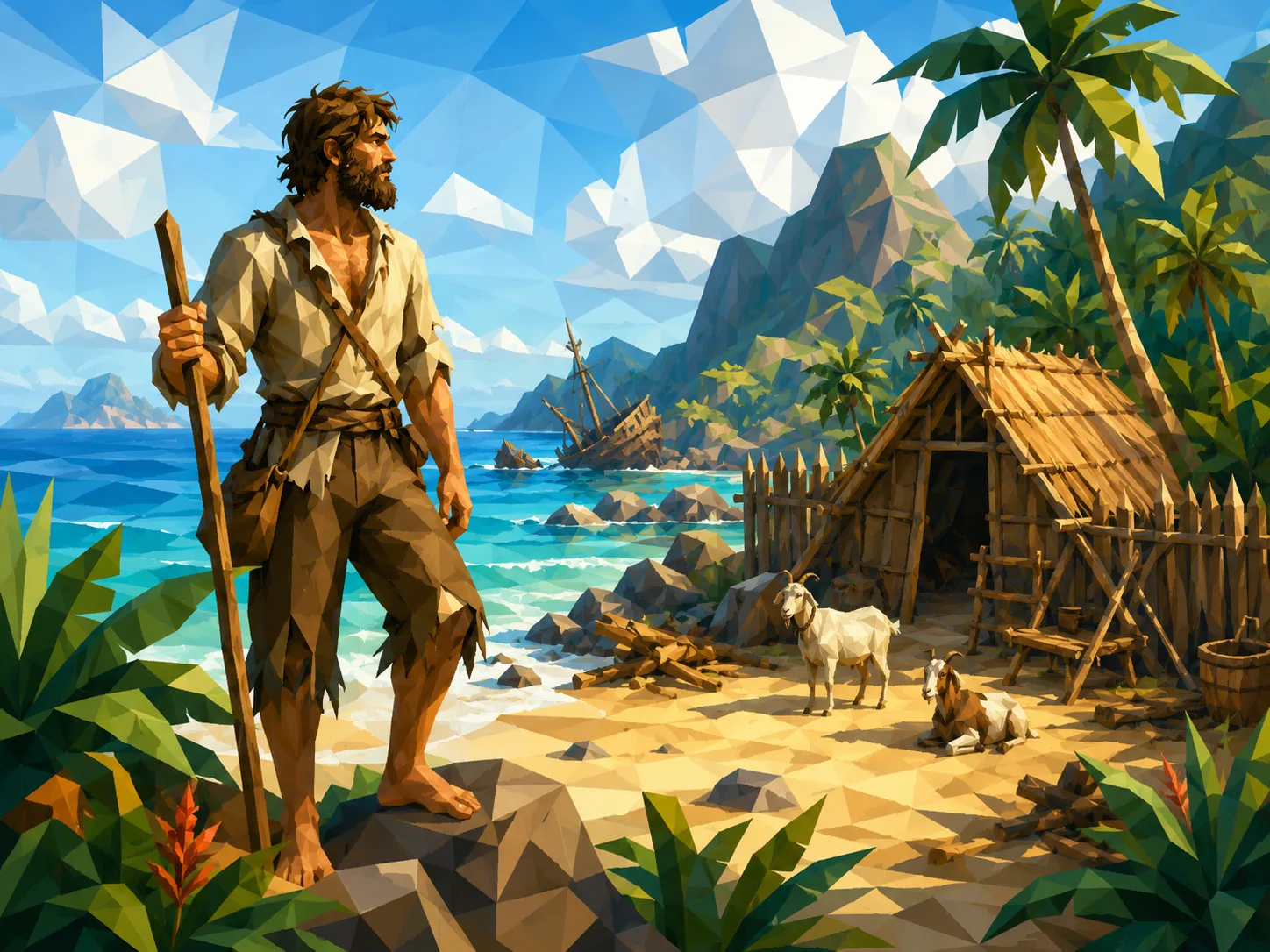
As I mentioned previously, I was determined to explore the entire island. I had already traveled up the brook to the place where I had built my bower, discovering an opening that led toward the sea on the opposite side of the island. Now, I resolved to travel all the way across to that shore. Taking my gun, a hatchet, and my dog, I packed a larger quantity of gunpowder and shot than usual. I also placed two biscuit cakes and a large bunch of raisins in my pouch for provisions before beginning my journey.
Once I had passed the valley where my bower stood, I came within sight of the sea to the west. It was a remarkably clear day, and I distinctly spotted land in the distance. I could not tell whether it was an island or a continent, but it was mountainous and extended far along the horizon. According to my estimate, it must have been at least fifteen or twenty leagues away.
I was unsure which part of the world this was, though I knew it must be a portion of America. I concluded that it was likely near the Spanish territories and perhaps inhabited by savages. Had I landed there, I might have found myself in a far worse condition than I was now. Consequently, I accepted the will of Providence, which I was beginning to believe ordered everything for the best. I quieted my mind with these thoughts and stopped tormenting myself with useless wishes to be on that distant shore.
Furthermore, I considered that if that land were indeed the Spanish coast, I would eventually see a vessel passing by. If it were not, then it must be the wild coast between the Spanish colonies and Brazil, inhabited by the most treacherous of savages—cannibals who murder and devour any human who falls into their hands.
With these thoughts in mind, I walked forward at a leisurely pace. I found this side of the island to be much more pleasant than my own. The open fields were beautiful, adorned with grass and flowers, and the region was filled with magnificent woods. I saw an abundance of parrots and wanted to catch one to keep as a pet, hoping I could teach it to speak. After some effort, I managed to stun a young parrot with a stick and brought it home. It was several years before I could get him to talk, but eventually, I taught him to call me by my name quite familiarly.
I was greatly entertained by this journey. In the lowlands, I found animals that looked like hares and foxes, though they differed greatly from any species I had seen before. Although I killed several, I could not bring myself to eat them. However, I had no need to be adventurous with my diet, as I had plenty of excellent food—specifically goats, pigeons, and turtles. Together with my grapes, my table was as well-provided as any market in London. Despite my deplorable circumstances, I had great cause for thankfulness; I was never driven to extremes for food but lived in relative plenty.
I never traveled more than two miles a day during this trip. I took so many detours to explore the surroundings that I was usually exhausted by the time I decided to stop for the night. I would then either sleep in a tree or surround myself with a fence of stakes driven into the ground to ensure no wild creature could approach me without waking me.
When I finally reached the seaside, I was surprised to realize that I had settled on the worst side of the island. Here, the shore was covered with countless turtles, whereas I had found only three in a year and a half on my side. There was also an infinite number of birds, many of which were excellent for eating, though I only knew the name of the penguins.
I could have shot as many as I liked, but I was very sparing with my ammunition. I preferred to hunt a she-goat if possible, as its meat was more sustaining. Although there were more goats here than on my side, it was much harder to get near them. The land was flat and open, allowing the animals to see me long before I could get within range.
Even though this side of the country was much more attractive, I had no desire to move. My original habitation had become my home, and while I was on this journey, I felt like a traveler away from his own house. I walked along the shore toward the east for about twelve miles and set up a large pole as a marker. I decided that my next journey would be to explore the eastern side of the island until I reached this post again.
I chose a different path for my return, thinking I could easily find my way back by observing the landscape. However, I was mistaken. After walking a few miles, I descended into a vast valley so surrounded by hills and thick woods that I lost my sense of direction. The weather became misty for several days, and without the sun to guide me, I wandered aimlessly and with great unease. Eventually, I was forced to return to the seaside to find my marker and go back the way I had come. I traveled home by easy stages, as the weather was excessively hot and my equipment was very heavy.
During the journey, my dog caught a young kid. I ran to save it and managed to take it alive. I was eager to bring it home, as I had often wondered if I could breed tame goats to provide food once my gunpowder was exhausted. I made a collar and a leash out of rope-yarn and led the creature along with some difficulty. When I reached my bower, I left the kid inside the fence, as I was impatient to be home after being away for over a month.
I cannot describe the profound sense of satisfaction I felt upon returning to my old dwelling and lying down in my hammock. This wandering journey had been so uncomfortable that my own house felt like a magnificent settlement by comparison. I was so content that I resolved never to go on such a long journey again while I remained on the island.
I rested for a week, spending much of my time building a cage for Poll, the parrot, who was becoming quite domestic. Then I remembered the poor kid I had left at the bower. When I went to fetch it, I found the poor creature nearly starving. I fed it with boughs and shrubs, and it became so grateful and tame that it followed me home like a dog. From that day on, it became another of my pets and would never leave my side.
The autumn rainy season arrived, and on the 30th of September, I observed the second anniversary of my landing with the same solemnity as before. I had now been on the island for two years, and my prospects for rescue were no better than on the first day. I spent the day in humble prayer, thanking God for the many mercies He had shown me in my solitude. I realized that I was perhaps happier in this isolated condition than I would have been in the busy world, where I had previously led such an immoral and shameful life.
My desires and tastes had completely changed. Previously, during my walks or hunts, I would be overcome by sudden bouts of anguish. I would feel like a prisoner, locked behind the eternal bars of the ocean in an uninhabited wilderness. These thoughts would strike me like a storm, leaving me weeping or sitting in silent grief for hours.
But now, I found comfort in the Word of God. One morning, feeling particularly sad, I opened the Bible to the words: "I will never, never leave you, nor forsake you." I immediately felt that these words were meant for me. If God was with me, it did not matter if the rest of the world had forsaken me. I even reached a point where I was almost ready to thank God for bringing me to this place. However, I stopped myself, realizing I would be a hypocrite to pretend I preferred this to being rescued. Instead, I gave sincere thanks for the fact that my eyes had been opened to my past wickedness.
I began my third year with a regular routine. I divided my time into specific duties: first, my religious devotion and reading the Scriptures three times a day; second, hunting for food for about three hours every morning; and third, the laborious task of preparing and cooking my meals. Because of the intense midday heat, I could only work for about four hours in the evening.
Every task took a tremendous amount of time because I lacked proper tools and help. For example, it took me forty-two days to make a single wooden shelf for my cave. I had to cut down a large tree, spend days removing the branches, and then painstakingly chip away at the wood with my hatchet until I had a flat board three inches thick. What two men with a saw could have done in half a day took me weeks of exhausting labor. Nevertheless, patience and hard work allowed me to finish everything that was necessary.
In November and December, I prepared to harvest my barley and rice. I had only a small amount of seed—about half a peck of each—but the crop looked promising. Suddenly, I found my harvest threatened by enemies. Goats and animals I called hares were eating the young green stalks as soon as they appeared. To save my crop, I had to build a hedge around the field, a task that required three weeks of intense toil. I also kept my dog tied to a stake at night to bark and keep the animals away.
Once the stalks grew, however, a new threat appeared: birds. As the grain began to ripen, clouds of birds circled the field, waiting for me to leave. I was devastated, fearing that they would eat all my hopes for bread and leave me to starve. I fired my gun at them, and a huge flock rose from the corn. I realized that if I did not act, I would never be able to raise a crop.
I stayed and watched the field, and as soon as I walked away, the "thieves" returned to the trees, waiting for their chance. I was so provoked that I fired again, killing three of them. I decided to treat them as we treat criminals in England: I hanged them in chains as a warning to the others. The effect was incredible. Not only did the birds stop eating the corn, but they abandoned that entire part of the island. By the end of December, I reaped my first successful harvest.
I had no scythe or sickle, so I used a sharpened cutlass to cut the ears of corn, which I carried away in baskets. From my small amount of seed, I managed to produce nearly two bushels of rice and over two bushels of barley. This was a great encouragement, as I could finally see a future where I would have bread. However, I still faced many challenges: I didn't know how to grind the grain into flour, how to clean it, or how to bake it. I resolved not to eat any of this crop but to save it all for seed for the next season.
I was now truly "working for my bread." I realized how many thousands of little things are necessary to produce a single loaf of bread. I had no plow, no spade, and no harrow. I had to use a wooden spade that wore out quickly and drag a heavy tree branch over the ground to cover the seeds. I lacked a mill, sieves for the flour, yeast, salt, and an oven. Yet, the prospect of having corn was an inestimable comfort. I decided that I would spend the next six months using all my ingenuity and labor to create the tools I needed to turn my grain into food.