


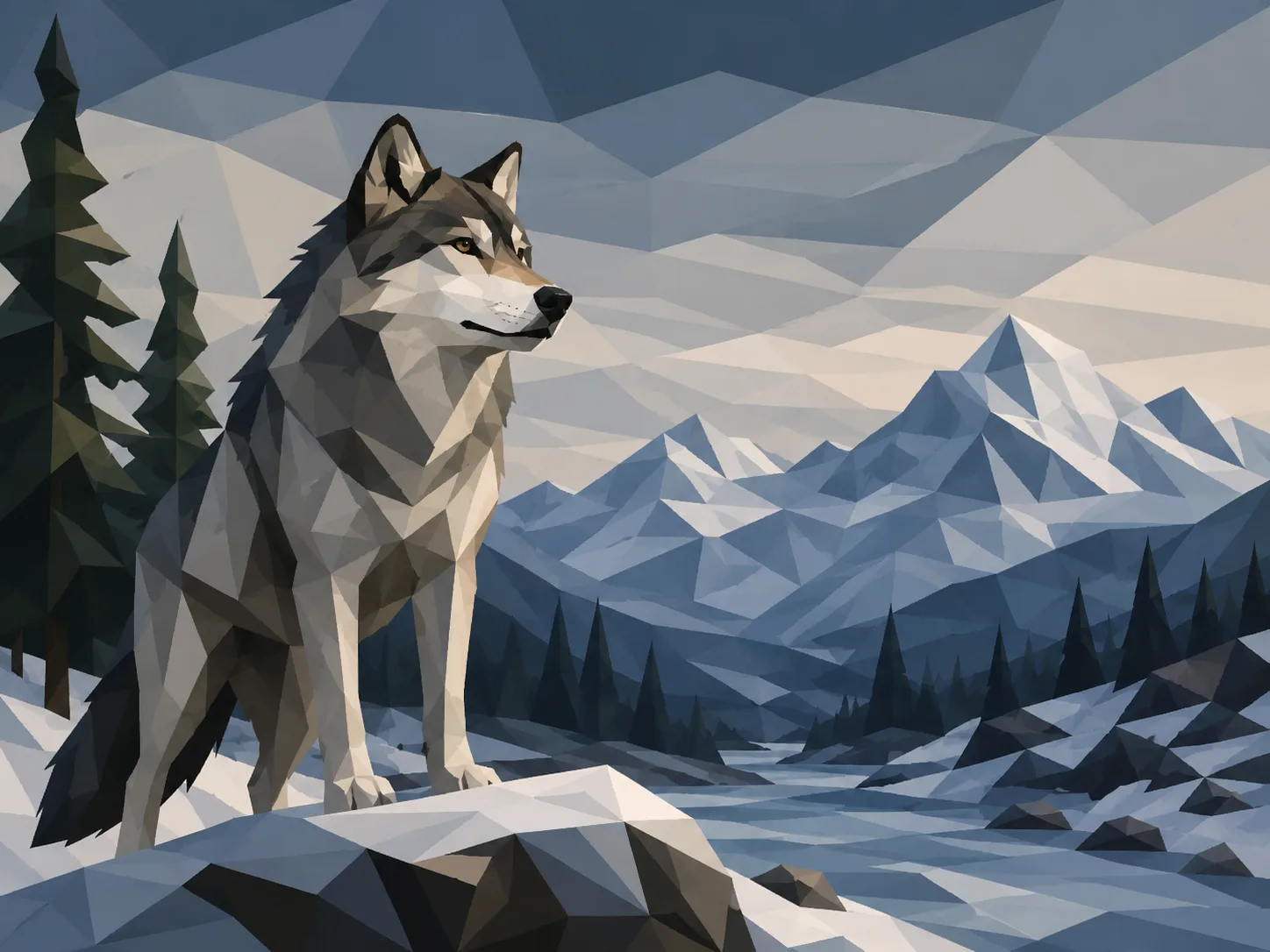
He was different from his brothers and sisters. While their fur already revealed the reddish tint inherited from their mother, he alone took after his father. He was the only grey cub in the litter—a true descendant of the wolf-stock, looking exactly like One Eye, except for one detail: he had two eyes instead of one.
The grey cub’s eyes had not been open long, yet he could already see with remarkable clarity. Even before he could see, however, he had experienced the world through touch, taste, and smell. He knew his siblings well, having already begun to engage in awkward, feeble wrestling matches. He had also learned to recognize his mother as a source of warmth and liquid food. Her gentle, caressing tongue soothed his soft body, making him feel secure enough to drift into a deep sleep.
He spent most of his first month sleeping, but as his vision improved, he stayed awake longer to study his surroundings. His world was dim and gloomy, but since he knew no other, he did not find it depressing. To him, the limits of his existence were the walls of the cave.
Early on, he discovered that one wall was different from the rest. This was the mouth of the cave, the source of all light. Even before his eyes opened, he had been irresistibly drawn to it. The light seemed to pull him forward, much like a plant turns toward the sun. In his early, unconscious days, he and his siblings would always crawl toward that bright opening, never toward the dark corners at the back.
As he developed a personality of his own, the attraction of the light grew stronger. He was constantly trying to reach it, only to be driven back by his mother. Through her, the cub learned about pain. If he crawled too far, he received a sharp nudge from her nose or a heavy blow from her paw that sent him rolling. Consequently, he learned his first life lessons: how to avoid being hurt and how to retreat when danger was near.
He was a fierce little cub, perhaps the most aggressive of the litter. Born from a line of meat-killers, his instincts were sharp. Even at a month old, he was beginning to eat meat that the she-wolf prepared for them. His tiny rages were more intense than those of his siblings; he was the first to learn how to pin another cub down with his paw or tug on an ear with his small, sharp teeth.
The "wall of light" remained a source of constant fascination. He did not understand that it was an entrance to a wider world; to him, it was simply a wall that his father could miraculously walk through and disappear. When the cub tried to do the same with the other walls, he only ended up with a bruised nose. He didn't wonder why his father could do this; he simply accepted it as a fact of life, just as he accepted that his mother provided milk.
Like most creatures of the Wild, the cub soon experienced the cruelty of famine. There came a time when the meat supply vanished and his mother’s milk ran dry. The cubs, once full of energy and tiny rages, became silent and weak. They spent most of their time in a state of hungry exhaustion.
One Eye was desperate. He searched far and wide for food, rarely returning to the miserable cave. The she-wolf also began to leave the litter to hunt. However, the Indian camp had moved away with the melting snows, closing off their easiest source of food.
When the grey cub finally regained enough strength to take an interest in the world again, he found that his world had grown smaller. Only one sister remained. The others were gone. As he grew stronger on the small scraps of meat his mother brought, he was forced to play alone. His sister no longer lifted her head; she was merely a tiny skeleton covered in fur. Eventually, the flame of her life flickered out completely.
Then came the time when the cub no longer saw his father at all. One Eye had vanished forever during a second, less severe famine. The she-wolf knew the truth, though she could not explain it to her son. While hunting near the left fork of the stream, she had followed One Eye’s day-old trail and found what remained of him. The signs in the snow told a story of a great battle with a lynx—a battle that One Eye had lost. The she-wolf had even found the lynx’s lair, but knowing the feline was inside with a litter of kittens, she had not dared to enter.
From then on, she avoided the left fork of the stream. She knew the lynx was a fierce, bad-tempered fighter, especially when protecting her young. A lone wolf was no match for a mother lynx in her own den. But the Wild is unpredictable, and the time would come when the she-wolf, driven by her own fierce motherhood, would have to face the lynx’s wrath for the sake of her grey cub.