What the song is about
The singer goes to the supermarket with a
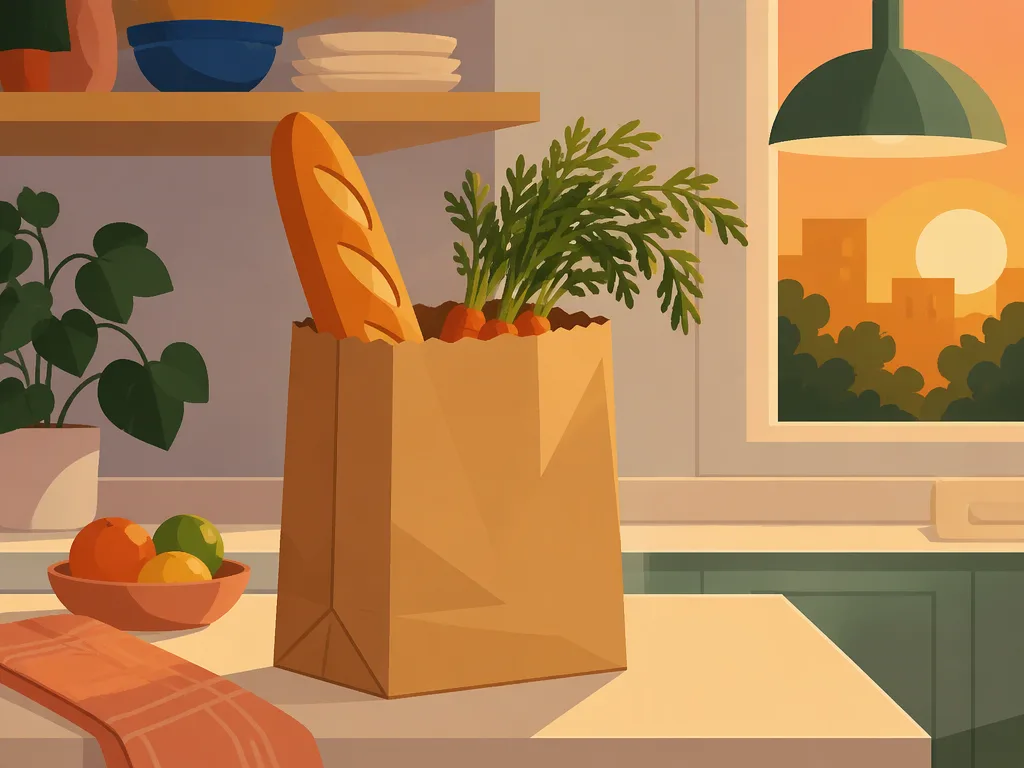
shopping list to buy food for tonight's dinner. They take a cart, walk through the different sections, choose fruit, vegetables, dairy products, bread, pasta and a little treat, and finally pay at the counter. It costs more than expected, but they are happy to feed their family.
Useful words and expressions
- shopping cart: the metal basket on wheels you push in a supermarket (British English: trolley)
- sliding doors: doors that open sideways automatically
- produce aisle: the part of the shop with fresh fruit and vegetables. Produce (stress on the first syllable) means fresh farm food.
- aisle: a passage between shelves (the s is silent: /aɪl/)
- dairy case: the cold shelf with milk, butter and cheese
- groceries: the food and things you buy at a supermarket
- a bunch of bananas, a sack of rice, a jar of spice, a bar of chocolate, a loaf of bread: useful words for amounts and containers
- a treat: something nice you give yourself
- to take your sweet time: to do something slowly, without hurrying
- to check off / check every line: to mark items on a list as done
- it passes every test: it is perfect, it is good in every way
- to bring home the bacon: an idiom meaning to earn money for your family
- the counter: where you pay (also the checkout)
Grammar
- Present simple for a sequence of actions: I walk through the sliding doors, I take a shopping cart, I go to the counter.
- Present continuous for what is happening right now: I am checking every line, I am working very hard. The chorus also uses -ing forms without a subject: Rolling down the aisles, Looking at the prices.
- Infinitive of purpose (to + verb to say why): to cook a meal, to find the dairy case, to pay for what I bought.
- Past simple of irregular verbs: buy → bought, think → thought.
- Comparison: more than I first thought.
- Future with will: I will feed my family.
Careful: changes made for the rhyme
- "apples red" and "lemons sour": in normal English the adjective comes before the noun: red apples, sour lemons.
- "and lemons sour instead": instead is only there to rhyme with red; it does not mean anything here. Just say and some sour lemons.
- "the cooking will awaken" is a poetic line to rhyme with bacon; it is not a normal expression. You could say I'll start cooking soon.
- "Buying all the groceries is a modern art" is a playful line for the rhyme, not a common saying.