


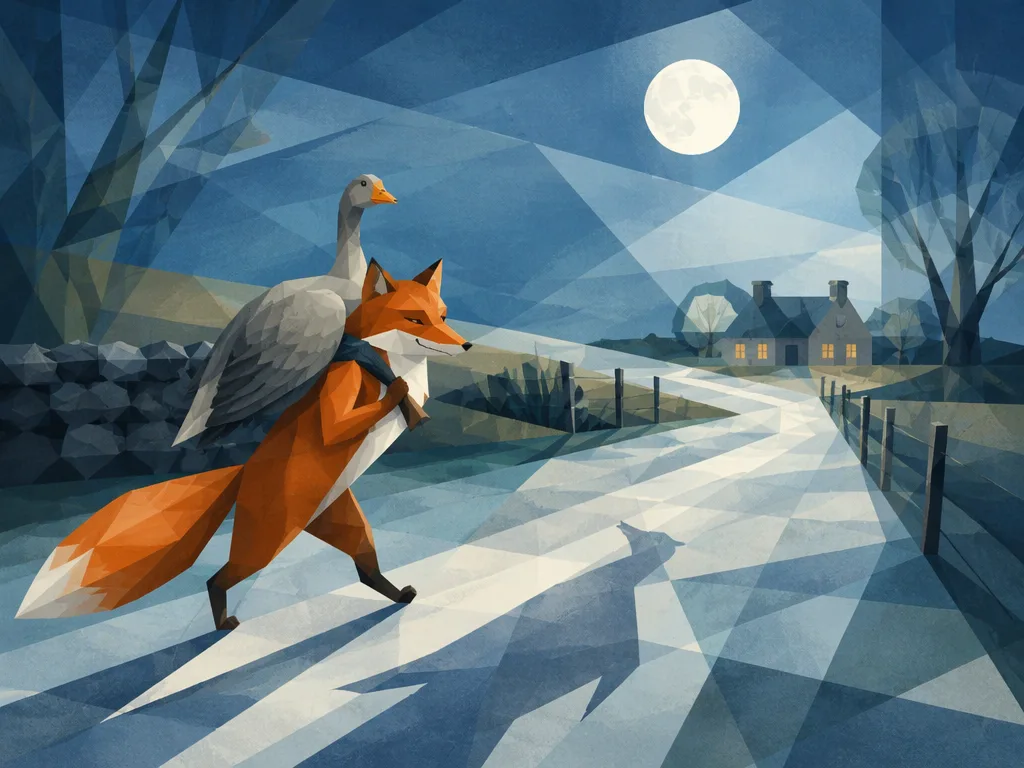
What the song is about
This is a well-known traditional folk song. On a cold night a fox goes out and asks the moon for light, because he has a long way to go to the town. He reaches a farmer's pen full of ducks and geese, grabs a gray goose by the neck and throws a duck over his back. The duck says "quack, quack, quack", but the fox doesn't care. At home in his warm den his little ones say the town must be wonderful and he should go back again. Then the fox and his wife cut up the goose, and the children chew on the bones.
Useful words and expressions
- a chilly night: a cold night
- to pray for something: to ask God (or here, the moon) for something you want very much
- a pen: a small fenced area where farm animals are kept
- ducks and geese: geese is the irregular plural of goose
- to grab someone by the neck: to take hold of them quickly by the neck
- to dangle: to hang down loosely; the legs all dangling down
- He didn't mind...: it didn't bother him
- a den: the home of a wild animal like a fox
- the little ones: the children, the young animals
- without any strife: without fighting or arguing
- a carving knife: a big knife for cutting meat
- to chew on something: to bite it again and again
- to grease my chin (folk idiom): to eat something rich and fatty, so the grease gets on your chin
- mighty fine (informal, American): very good
Grammar
Past simple for telling a story. The song tells its story in the past simple, with many irregular verbs: went, ran, came, said, threw, cut, had. Regular verbs end in -ed: prayed, reached, grabbed, chewed.
ran till he came to... Till (= until) shows that one action continues up to another one: He ran till he came to the farmer's pen.
Future with will. The fox makes a prediction: A couple of you will grease my chin.
Must for a logical guess. It must be a mighty fine town means "we are sure it is a very good town" (because their father brought such good food).
before + present tense. In Before I leave this town, English uses the present tense after before, even when it talks about the future.
Old-fashioned and song-only forms (don't copy these)
- town-o, down-o, bones-o: the extra -o is a folk-song habit for rhythm and rhyme. It is not a real word ending. Just say town, down, bones.
- He'd many a mile to go: here he'd = he had. Shortening had as a main verb like this is old-fashioned. Today we say He had many miles to go. Many a + singular noun (many a mile) is also old and poetic.
- were kept therein: therein (= in it, in there) is very formal and old. Say were kept inside.
- Daddy, better go back again: normal English is you'd better go back. Dropping you'd is very informal speech.
- They never had such a supper in their life: normal written English would be They had never had such a supper in their lives. The song keeps it short for the rhythm.
- A couple of you will grease my chin: the eaten birds don't really grease his chin; I'll grease my chin with a couple of you would be clearer. The song bends it for rhyme with pen and therein.