


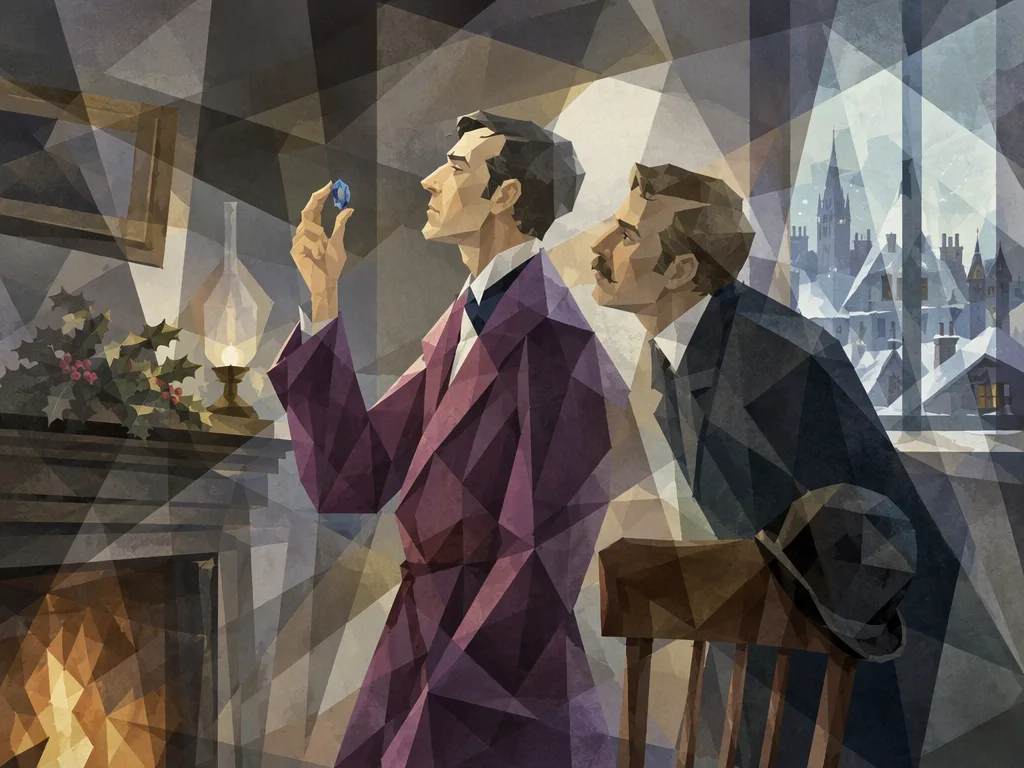
"Well, Watson," said Holmes after our visitor had left, "what do you make of it all?"
"I make nothing of it," I answered honestly. "It is a complete mystery."
"As a rule," said Holmes, "the stranger a case appears, the simpler it turns out to be. It is the ordinary, featureless crimes that are truly puzzling—just as an ordinary face is the hardest to recognize. Still, I must act quickly here."
"What are you going to do, then?" I asked.
"To smoke," he answered. "It is quite a three-pipe problem, and I beg that you won't speak to me for fifty minutes."
He curled himself up in his armchair with his thin knees drawn up toward his sharp nose, shut his eyes, and sat there with his black clay pipe sticking out like the beak of a strange bird. I thought he had fallen asleep, and I was beginning to nod off myself, when he suddenly sprang out of the chair like a man who had made up his mind, and laid his pipe on the mantelpiece.
"There is a fine violin concert at St. James's Hall this afternoon," he remarked. "What do you say, Watson? Could your patients spare you for a few hours?"
"I have nothing urgent today. My practice never keeps me very busy."
"Then put on your hat and come along. I am going into the City first, and we can have lunch on the way. I see there is plenty of German music on the program, which suits my mood better than Italian or French. It makes a man think, and I want to think. Come on!"
We took the underground train as far as Aldersgate, and a short walk brought us to Saxe-Coburg Square, the scene of the strange story we had heard that morning. It was a cramped, shabby, quiet little square. Four rows of dull two-story brick houses looked onto a small fenced garden, where a patch of weedy grass and a few dusty bushes fought hard against the smoky air. On a corner house hung three gold balls and a brown sign with "JABEZ WILSON" painted in white letters, marking our red-headed client's shop.
Sherlock Holmes stopped in front of it, tilted his head, and looked the whole house over, his bright eyes gleaming between half-closed lids. Then he strolled slowly up the street and back to the corner, studying the houses carefully. Finally he returned to the pawnbroker's door, struck the stone pavement hard with his walking stick two or three times, walked up the steps, and knocked.
A bright-looking, clean-shaven young man opened the door at once and invited him inside.
"Thank you," said Holmes. "I only wished to ask how to get from here to the Strand."
"Third right, fourth left," the assistant answered promptly, and shut the door.
"A clever fellow, that," remarked Holmes as we walked away. "He is, in my judgment, the fourth smartest man in London, and for daring I am not sure that he has not a claim to be third. I have known something of him before."
"Clearly," I said, "Mr. Wilson's assistant plays a major part in this mystery of the Red-Headed League. I am sure you asked the way merely so you could get a look at him."
"Not him."
"What then?"
"The knees of his trousers."
"And what did you see?"
"What I expected to see."
"And why did you beat the pavement?"
"My dear Doctor, this is a time for watching, not for talk. We are spies in an enemy's country. We know something of Saxe-Coburg Square now. Let us look at the street that lies behind it."
We turned the corner from the quiet little square and stepped into a street that made the sharpest possible contrast to it—like seeing the bright front of a painting after looking at the back. It was one of the main roads carrying City traffic north and west. Wagons and cabs jammed the roadway in a double stream, while the sidewalks were black with hurrying crowds. Looking at the row of tall, handsome shops and grand business buildings, it was hard to believe they backed directly onto the dull, faded square we had just left.
"Let me see," said Holmes, pausing at the corner to look down the row. "I should like to fix the order of these buildings in my mind. Knowing London inside and out is a hobby of mine. Here is Mortimer's tobacco shop, the little newspaper shop, the Coburg branch of the City and Suburban Bank, the Vegetarian Restaurant, and McFarlane's carriage works. That brings us to the next block. Now, Doctor, our work is done, so it is time for some play. A sandwich and a cup of coffee, and then off to music, where everything is sweet and peaceful and there are no red-headed clients to puzzle us with riddles."
My friend was a passionate lover of music, and no ordinary violinist and composer himself. All afternoon he sat in his seat wrapped in perfect happiness, gently waving his long thin fingers in time with the violins. His soft smile and dreamy eyes could not have looked more different from Holmes the ruthless, keen-eyed hunter of criminals. Yet I had seen this double side of his nature many times before. He often swung from days of lazy dreaming to bursts of fierce energy. I knew well that he was never more dangerous than after lounging quietly in his chair among his music and old books. Then the thrill of the hunt suddenly seized him, and his sharp reasoning power worked so fast it seemed almost like magic. Sitting beside him in the concert hall that afternoon, watching him lost in the sound of the violins, I felt sure that a bad time was coming for the people he had chosen to hunt down.
"You want to go home now, no doubt, Doctor," he said as we stepped out into the street.
"Yes, it would be wise."
"I have some business to settle that will take a few hours. This affair at Saxe-Coburg Square is serious."
"Why serious?"
"A major crime is being planned. I have every reason to believe we will be in time to stop it. Still, today being Saturday makes things harder. I shall need your help tonight."
"At what time?"
"Ten o'clock will be early enough."
"I will be at Baker Street at ten."
"Very well. And, Doctor, there may be a little danger, so kindly put your army revolver in your pocket." He gave a wave of his hand, turned sharply on his heel, and vanished into the crowd.
I do not think I am slower than most men, yet around Sherlock Holmes I always felt painfully dull. I had heard everything he had heard, and seen everything he had seen. From his words, however, it was clear he already knew not only what had happened, but what was about to happen—while to me the entire business remained dark and confusing. As I rode home to my house in Kensington, I turned every clue over in my mind: the absurd job of copying the encyclopedia, our trip to Saxe-Coburg Square, and Holmes's grim warning at the end. What was this nighttime adventure, and why did I need a gun? Where were we going, and what would we do? Holmes had hinted that the smooth-faced assistant was a dangerous man playing a deep game. I tried to piece it together, gave up in despair, and decided to wait until night brought the answer.
At a quarter past nine I set out from home and walked across the park toward Baker Street. Two cabs stood waiting outside the door, and as I entered the hallway I heard voices upstairs. When I walked into the sitting room, I found Holmes talking briskly with two men. One I recognized as Mr. Peter Jones, the detective from Scotland Yard. The other was a long, thin, sad-faced gentleman wearing a very shiny top hat and a stiff, respectable black coat.
"Aha! Our party is complete," said Holmes, buttoning his heavy coat and taking his thick hunting whip from the rack. "Watson, I believe you know Mr. Jones, of Scotland Yard? Allow me to introduce Mr. Merryweather, who will join us in tonight's adventure."
"We are hunting in pairs again, Doctor, you see," said Jones in his loud, self-important voice. "Our friend here is wonderful at starting a chase. All he needs is an old dog like me to help him run the fox down."
"I only hope this is not a wild goose chase," said Mr. Merryweather gloomily.
"You can safely trust Mr. Holmes, sir," said Jones proudly. "His little methods are a bit dreamy and fanciful, if he doesn't mind my saying so, yet he has the makings of a real detective in him. More than once, I must admit, he has come closer to the truth than Scotland Yard itself."
"Oh, if you say so, Mr. Jones, then it must be all right," replied Merryweather respectfully. "Still, I confess I miss my Saturday night card game. This is the first Saturday night in twenty-seven years that I have missed my game."
"I think you will find," said Sherlock Holmes, "that you are playing for a higher stake tonight than you have ever played for before, and that the game will be far more exciting. For you, Mr. Merryweather, the stake is thirty thousand pounds. And for you, Jones, it is the man you have been trying to get your hands on."
"John Clay, the thief and forger!" exclaimed Jones. "He is young, Mr. Merryweather, but he stands at the very top of his trade. I would rather snap my handcuffs on him than on any criminal in London. He is a remarkable man, is young John Clay. His grandfather was a royal duke, and he himself went to Eton and Oxford. His brain is as sharp as his fingers. We find signs of him everywhere, yet we never know where to catch the man himself. He will rob a house in Scotland one week, and raise money to build an orphanage in Cornwall the next. I have been on his trail for years and have never set eyes on him yet."
"I hope to have the pleasure of introducing you tonight," said Holmes. "I have crossed paths with Mr. John Clay once or twice myself, and I agree he is at the top of his trade. It is past ten, however, and time to start. If you two take the first cab, Watson and I will follow in the second."
Sherlock Holmes said very little during the long drive. He leaned back in the cab, softly humming the tunes we had heard at the concert that afternoon. Our wheels rattled through a maze of gas-lit streets until at last we came out into the City.
"We are nearly there now," Holmes said. "This Mr. Merryweather is a bank director, and personally concerned in the affair. I thought it wise to bring Jones along too. He is not a bad fellow, even though he is hopelessly stupid at his job. He has one great quality, though: he is as brave as a bulldog, and once he gets his claws into someone, he holds on like a lobster. Here we are, and they are waiting for us."