


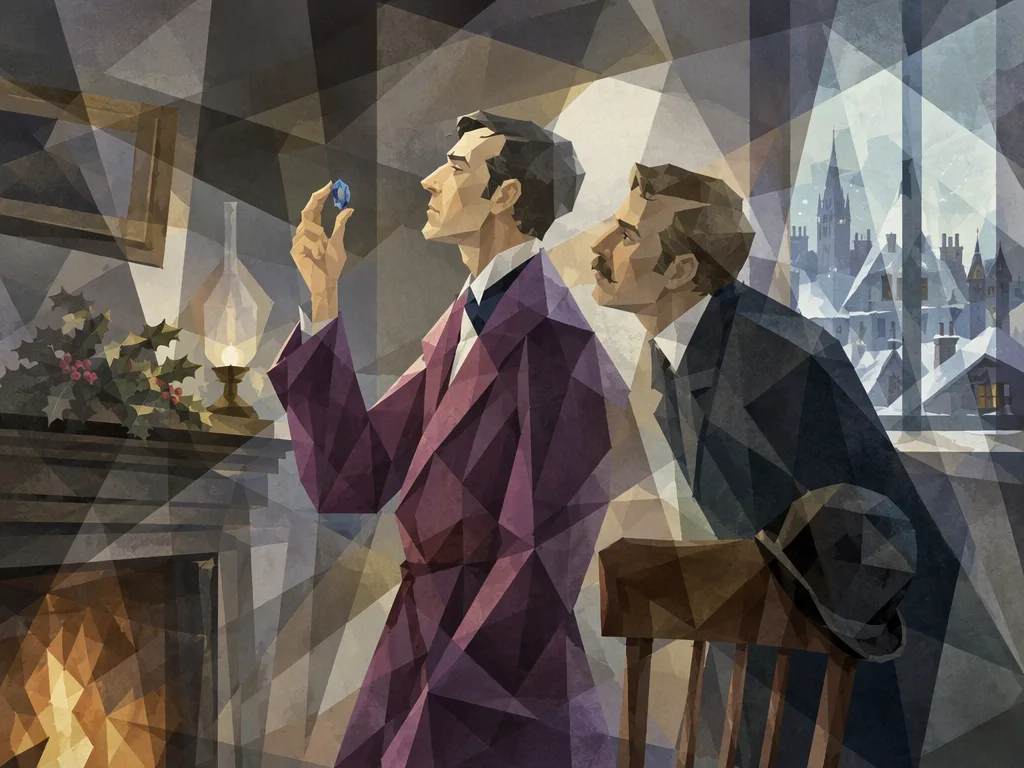
On the second morning after Christmas, I went to visit my friend Sherlock Holmes at 221B Baker Street to wish him well for the holiday season. A sharp frost had settled over London, and the windowpanes were thick with ice. Although my marriage and my medical practice kept me busy in my own home, I still called at our old rooms whenever I had a free hour.
I found Holmes lounging on the sofa in a purple dressing gown. A pipe rack stood within reach on one side, and a pile of crumpled morning newspapers lay close by, clearly just read. Beside the sofa was a wooden chair, and hanging on the corner of its back was a very shabby black felt hat, battered and cracked in several places. A magnifying glass and a pair of tweezers lay on the chair seat, showing that he had hung the hat there to study it carefully.
"You are busy," I said. "Perhaps I am interrupting you."
"Not at all. I am glad to have a friend to discuss my results with. The matter is a small one"—he pointed with his thumb toward the old hat—"yet there are details about it that are interesting and even worth studying."
I sat down in his armchair and warmed my hands before the crackling fire. "I suppose," I remarked, "that ordinary as it looks, this hat has some deadly story tied to it—that it is the clue that will guide you to solve some mystery and punish some crime."
"No, no. No crime," said Holmes, laughing. "It is only one of those odd little accidents that happen when four million people are crowded together in a few square miles. In such a dense crowd, almost anything can happen. Many strange puzzles turn up that are striking and unusual without being criminal. We have seen plenty of them before."
"Yes," I agreed. "Several of the cases I have added to my notes lately have been completely free of crime."
"Exactly. You are thinking of the business of the King of Bohemia's photograph, for example. Well, I have no doubt that this small affair belongs to the same harmless kind. You know Peterson, the messenger?"
"Yes."
"This prize belongs to him."
"It is his hat?"
"No, no, he found it. Its owner is unknown. Please look at it not as a battered old hat, but as an intellectual puzzle. First, let me tell you how it came here."
"It arrived on Christmas morning," Holmes went on, "together with a fine fat goose, which is probably roasting in front of Peterson's fire right now. These are the facts. About four o'clock on Christmas morning, Peterson—who, as you know, is a very honest fellow—was walking home down Tottenham Court Road after a small holiday celebration. Ahead of him in the gaslight, he saw a fairly tall man walking with a slight stagger and carrying a white goose slung over his shoulder. As the man reached the corner of Goodge Street, a fight broke out between him and a small gang of roughs. One of them knocked the man's hat off. The stranger raised his walking stick to defend himself, swung it over his head, and smashed the shop window behind him.
"Peterson ran forward to protect the stranger from his attackers. However, the man was shocked at breaking the window, and when he saw an official-looking man in uniform rushing toward him, he dropped his goose and took to his heels. In a moment he vanished into the maze of narrow streets behind Tottenham Court Road. The roughs fled too at the sight of Peterson. So Peterson was left in possession of the battlefield, along with his prizes—this battered hat and a splendid Christmas goose."
"Surely he returned them to their owner?" I asked.
"My dear fellow, that is where the problem lies. It is true that 'For Mrs. Henry Baker' was printed on a small card tied to the bird's left leg. It is also true that the initials 'H. B.' are written clearly on the lining of this hat. However, there are thousands of Bakers, and hundreds of Henry Bakers, in this city of ours. It is not easy to return lost property to one particular man among so many."
"What did Peterson do, then?"
"He brought both the hat and the goose around to me on Christmas morning, knowing that even the smallest puzzles interest me. We kept the goose until this morning. By then, in spite of the frost, there were signs that it ought to be eaten without further delay. Its finder carried it off to meet the natural fate of a goose, while I still have the hat of the unknown gentleman who lost his Christmas dinner."
"Did he not put an advertisement in the paper?"
"No."
"Then what clue do you have to who he is?"
"Only what we can deduce."
"From his hat?"
"Precisely."
"You are joking," I said. "What can you possibly learn from this battered old felt hat?"
"Here is my magnifying glass. You know my methods. What can you gather yourself about the man who wore this hat?"
I took the worn object in my hands and turned it over doubtfully. It was an ordinary round, hard black felt hat, badly worn. The lining had once been red silk, though it was now stained and faded. There was no maker's name, but as Holmes had said, the initials "H. B." were scribbled on one side. The brim had been pierced for a hat elastic, though the cord itself was missing. Beyond that, the hat was cracked, covered in dust, and spotted in several places, although someone had tried to hide the lighter stains by smearing them over with dark ink.
"I can see nothing," I said, handing it back to my friend.
"On the contrary, Watson, you can see everything. You fail, however, to reason from what you see. You are too timid in drawing conclusions."
"Then please tell me what you can deduce from this hat."
Holmes picked it up and gazed at it in the quiet, thoughtful way that was so characteristic of him. "Perhaps it tells less than some hats might," he remarked. "Still, there are several facts that are quite clear, and a few others that are at least strongly likely. First, it is obvious that the man is highly intelligent. It is also clear that he was fairly well off within the last three years, although he has now fallen on hard times. He used to plan ahead carefully, though he does so less today—which points to a weakening of character. Together with his loss of money, that suggests some bad habit, probably drink, has a hold on him. This may also explain the obvious fact that his wife has stopped loving him."
"My dear Holmes!"
"He has, however, kept some degree of self-respect," Holmes continued, ignoring my protest. "He leads a quiet indoor life, goes out very little, is completely out of shape, is middle-aged, and has graying hair that was cut within the last few days and dressed with lime cream. Those are the clearest facts to be deduced from his hat. Also, by the way, it is extremely unlikely that he has gas lighting in his house."
"You are certainly joking, Holmes."
"Not in the least. Is it possible that even now, after I have given you the answers, you cannot see how I reached them?"
"I suppose I am very slow," I admitted, "but I must confess I cannot follow you. For example, how did you deduce that this man is intelligent?"
For an answer, Holmes clapped the hat onto his own head. It came right down over his forehead and settled on the bridge of his nose. "It is a question of size," he said. "A man with so large a brain must have something in it."
"And the decline in his fortunes, then?"
"This hat is three years old. Flat brims curled at the edge like this came into fashion three years ago. It is a hat of the very best quality. Look at the thick silk band and the fine lining. If this man could afford to buy such an expensive hat three years ago, and has bought no new hat since, then he has certainly gone down in the world."
"Well, that is clear enough. What about the careful planning and the weakening of his character?"
Sherlock Holmes laughed. "Here is the proof of his careful planning," he said, placing his finger on the little metal disc and loop for a hat elastic. "Hats are never sold with these attached. If this man ordered one, it shows a certain foresight, since he took extra trouble to guard against the wind. Yet we see that the elastic broke and he never bothered to replace it. Clearly he takes less care now than he once did, which shows a weakening of character. On the other hand, he tried to hide some of these stains on the felt by dabbing them with ink. That proves he has not lost all self-respect."
"Your reasoning certainly sounds convincing."
"The other points—that he is middle-aged, that his hair is graying, that it was cut recently, and that he uses lime cream—can all be seen by looking closely at the lower part of the lining. My magnifying glass reveals dozens of tiny hair ends, cut cleanly by a barber's scissors. Many of them are gray, they stick slightly together, and there is a distinct smell of lime hair cream. As for the dust on the felt, notice that it is not the gritty gray dust of the street, but the soft brown dust of a house. That shows the hat hangs indoors most of the time. Meanwhile, the sweat stains on the inside prove that the wearer sweats very heavily, and so can hardly be in good physical shape."
"But his wife—you said she had stopped loving him."
"This hat has not been brushed for weeks. When I see you, my dear Watson, with a week's layer of dust on your hat, and when your wife allows you to go out in such a condition, I will fear that you too have been unfortunate enough to lose your wife's affection."
"He might be unmarried."
"No. He was bringing home the goose as a peace offering to his wife. Remember the card tied to the bird's leg."
"You have an answer for everything. Still, how on earth can you deduce that there is no gas lighting in his house?"
"One drop of candle wax, or even two, might fall by accident. But when I count no fewer than five drops of wax, there can be little doubt that this man handles burning candles very often. Most likely he walks upstairs at night with his hat in one hand and a dripping candle in the other. In any case, he never got candle wax from a gas lamp. Are you satisfied?"
"Well, it is very clever," I said, laughing. "Still, as you said just now, no crime has been committed, and no real harm has been done except the loss of a goose. All this seems rather a waste of energy."
Sherlock Holmes had just opened his mouth to reply when the door flew open. Peterson, the messenger, rushed into the room with flushed cheeks and the wide eyes of a man stunned with amazement.
"The goose, Mr. Holmes! The goose, sir!" he gasped.
"What about it, then?" Holmes twisted around on the sofa to get a better view of the man's excited face. "Has it returned to life and flown off through the kitchen window?"
"Look here, sir! Look what my wife found inside the goose!" Peterson held out his hand. Right in the center of his palm lay a brilliantly sparkling blue stone. It was a little smaller than a bean, yet so pure and bright that it shone like an electric light in the dark hollow of his hand.
Sherlock Holmes sat up with a low whistle. "By Jove, Peterson!" he said. "This is real treasure indeed. I suppose you know what you have found?"
"A diamond, sir? A precious stone. It cuts into glass as if it were soft putty."
"It's more than a precious stone. It is *the* precious stone."
"Not the Countess of Morcar's blue carbuncle!" I cried.