


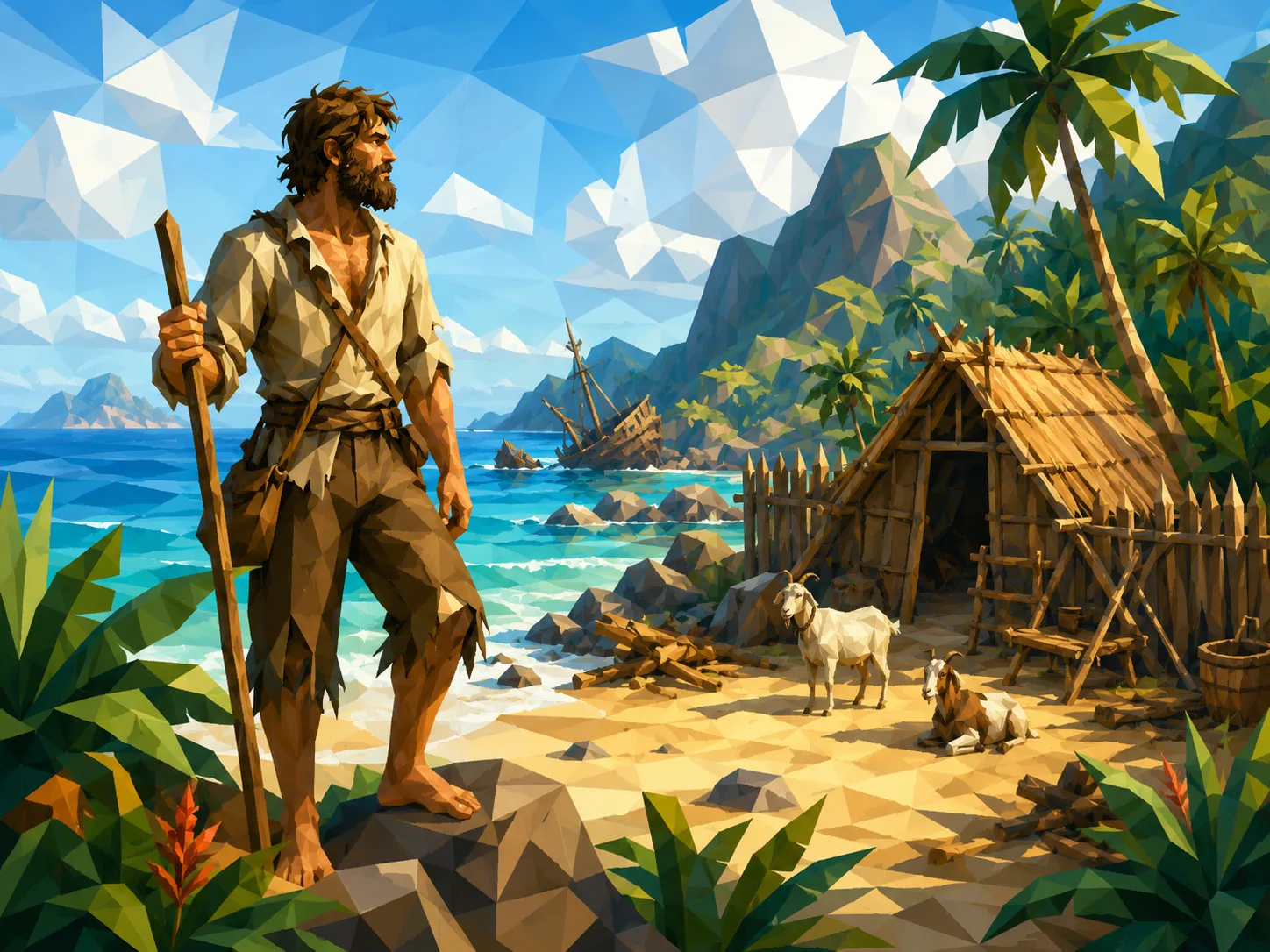
My first priority was to prepare more land, as I now possessed enough seed to sow more than an acre of ground. Before I could begin, however, I spent at least a week fashioning a spade. When it was finally finished, it was a crude and heavy tool that required double the effort to use. Nevertheless, I persevered and sowed my seeds in two large, flat areas near my house. I fenced them in with a sturdy hedge made of stakes I had cut earlier; I knew these would take root and grow, eventually forming a "living" fence that would require very little maintenance. This entire task occupied me for three months, largely because the rainy season frequently forced me to stay indoors.
While the rain kept me from the fields, I found various ways to occupy my time. I spent many hours talking to my parrot and teaching him to speak. Eventually, I succeeded in getting him to call out his own name, "Poll." This was the very first word I had heard spoken on the island by any voice other than my own. However, this was more of a hobby than actual work. My real labor involved a project I had been contemplating for a long time: the creation of earthenware vessels.
I desperately needed containers to hold my grain and meal, but I had no idea how to make them. Considering the intense heat of the climate, I was confident that if I could find suitable clay, I might be able to craft pots that would harden in the sun. These would be strong enough to handle dry goods, which was essential for my farming efforts.
It would likely make a reader pity me—or perhaps laugh at me—to hear of the many awkward methods I used. I struggled to raise the clay into the proper shape; I created countless odd, misshapen, and ugly objects. Many collapsed because the clay was too soft to support its own weight, while others cracked under the violent heat of the sun. After two months of exhausting labor—digging the clay, tempering it, and carrying it home—I managed to produce only two large, unsightly earthen jars.
Once the sun had baked them hard, I lifted them with great care and placed them inside two large wicker baskets I had woven specifically for this purpose. To prevent them from breaking, I stuffed the gaps between the jars and the baskets with rice and barley straw. These jars were meant to stay dry, and I intended to use them for storing my harvested corn and meal.
Although I had failed to make large, elegant pots, I had better success with smaller items. I crafted small round pots, flat dishes, and pitchers, which the sun baked until they were quite firm. Yet, none of these could hold liquids or withstand the heat of a fire.
One day, after I had finished cooking some meat, I noticed a broken piece of one of my clay vessels lying in the embers. To my surprise, it had been burned as hard as stone and was as red as a roof tile. This discovery sparked a new idea: if a broken piece could be hardened by fire, surely a whole vessel could be as well.
I began to study how to manage a fire to "bake" my pottery. I knew nothing of professional kilns or lead glazing, but I piled several pots and jars together and surrounded them with firewood and a thick bed of glowing coals. I kept the fire burning intensely until the pots inside were glowing red-hot. I maintained this heat for five or six hours, noticing that while they didn't crack, the sand in the clay began to melt. I gradually reduced the fire, watching them through the night so the temperature wouldn't drop too quickly. By morning, I had three very sturdy clay pots and two other vessels, one of which was perfectly glazed by the melted sand.
After this success, I was never short of earthenware. Though their shapes were clumsy—looking more like something a child would make out of mud—their utility was undeniable. No joy could equal mine when I realized I finally had a pot that could withstand the fire. I could hardly wait for them to cool before I put one on the hearth to boil some meat. It worked perfectly, and I enjoyed a delicious broth made from a piece of kid.
My next challenge was to create a stone mortar to grind my grain, as a proper mill was far beyond my abilities. I spent many days searching for a suitable stone, but the rocks on the island were too soft and crumbly. If I had used them, they would have filled my flour with sand. Eventually, I gave up on stone and found a heavy block of hard wood instead. With immense labor and the help of fire, I hollowed it out, much like the natives of Brazil carve their canoes. Then, I fashioned a heavy pestle from "iron-wood" and set it aside for my next harvest.
Furthermore, I needed a sieve to separate the flour from the bran. This seemed impossible, as I had no fine cloth or canvas. I was stuck for many months until I remembered some calico and muslin neckcloths I had salvaged from the ship’s chests. With these, I made three small sieves that served me well for several years.
Baking was the final hurdle. I had no yeast, so I didn't worry about making light bread, but I did need an oven. I experimented by making broad, shallow clay vessels about two feet wide and nine inches deep. When I wanted to bake, I would build a large fire on my hearth until the tiles were extremely hot. Then, I would sweep away the embers, place my loaves on the hot hearth, and cover them with the clay vessel. By heaping the glowing coals around the outside of the pot, I created a perfect oven. In this way, I baked barley loaves and rice cakes, becoming quite a skilled cook in the process.
All these tasks occupied most of my third year on the island. During this time, I also managed my harvests, eventually collecting about twenty bushels each of barley and rice. With my stocks increasing, I realized I had more than enough to last a year, and I resolved to use my grain more freely.
Despite my relative comfort, my thoughts frequently turned to the mainland I had seen in the distance. I secretly wished to escape, though I knew the dangers. I was aware that the inhabitants of that coast might be cannibals, and even if they weren't, they might kill me as they had done to other Europeans. Nevertheless, my desire to reach the shore grew.
I thought of the ship’s boat that had been washed up during the original storm. It lay upside down on a high ridge of sand. I tried to use levers and rollers to turn it over, spending three or four weeks in fruitless toil. I even tried to dig the sand out from under it, but it was simply too heavy for one man to move.
Finally, I decided to build my own canoe, or periagua, by hollowing out the trunk of a massive tree. I was so focused on the idea of sailing across the sea that I completely ignored the logistics of getting the boat into the water. It was a foolish mistake. I felled a magnificent cedar tree—nearly six feet in diameter—and spent months hacking away the branches and shaping the hull with my axe and chisel. It was a beautiful boat, large enough to carry twenty-six men.
When it was finished, I was delighted, but then came the impossible task of launching it. The boat lay about a hundred yards from the water, but it was uphill from the creek. I tried to dig a slope in the ground, but the boat still wouldn't budge. Finally, I calculated that I would need to dig a canal to bring the water to the boat. However, I realized that as a single man, it would take me ten or twelve years to finish the excavation. Heartbroken, I was forced to abandon the project. I saw then, too late, the folly of beginning a work without first counting the cost.
In the midst of this disappointment, I reached the end of my fourth year. Through constant study of the Bible, I had found a new kind of peace. I began to look at the world as something remote and unnecessary. I was the "lord" of the island; I had no rivals and no reason for greed. I had more corn, timber, and livestock than I could ever use.
I realized that the good things of this world are only valuable in so far as we can use them. Even the gold and silver I had salvaged—about thirty-six pounds—lay moldy in a drawer. I would have traded it all for a handful of carrot seeds or a few tobacco pipes. I learned to focus on what I enjoyed rather than what I lacked. My discontent, I realized, sprang from a lack of thankfulness.
I often reflected on how much worse my life could have been if the ship had not drifted close to shore, providing me with tools and supplies. Without them, I would have lived like a savage, eating raw meat and possessing no means of defense. These thoughts made me deeply grateful for my current condition. I repented for my past life—a life spent without the fear of God—and I felt that my repentance had been accepted. My life was a series of miracles, and I lacked nothing but human society to make it comfortable.
By this time, many of my supplies were running out. My ink was almost gone, so I used it sparingly to record significant dates. I noticed a strange coincidence: many major events in my life had happened on the same days of the year. For instance, I was cast away on this island on my birthday, September 30th.
My clothes were also falling apart. To solve this, I began to experiment with the skins of the animals I had killed. I fashioned a large cap and a suit consisting of a waistcoat and breeches. They were clumsily made, but since I wore the hair on the outside, they kept me dry in the rain and protected my skin from the blistering sun.
Lastly, I spent a great deal of effort making a folding umbrella covered in skins. It was difficult to design a mechanism that would allow it to open and close, but I eventually succeeded. Covered with hair to shed the rain, it allowed me to walk outdoors in the hottest weather or the heaviest storms. I lived quite comfortably now, having resigned myself to the will of God and finding peace in my own thoughts.