


Theme & Story
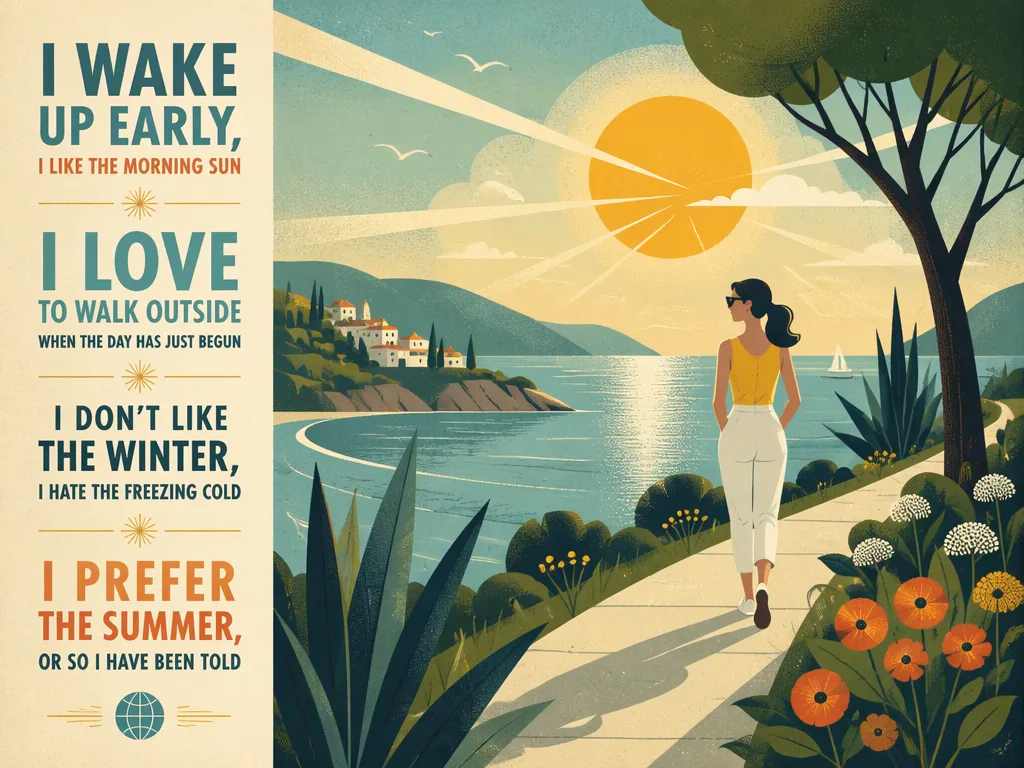
This song is a simple, cheerful declaration of personal preferences. The singer lists things they like and dislike: morning sunshine, quiet places, friendly voices, reading in bed, summer over winter, the country over the town. The story is not dramatic; instead, it feels like a calm self-portrait. The main message is: everyone has their own choices, and it is okay to know what you enjoy.
The repeated lines make the song especially useful for language learners because they practice everyday structures for expressing opinions: I like, I don't like, I love, I hate, I prefer, I can't stand, and I'd rather.
Metaphors & Meaning
The lyrics are mostly literal, but a few phrases carry extra meaning:
- “Sweet or salty, fast or slow” represents different options in life. It suggests that people can have opposite tastes, and neither choice is wrong.
- “That’s just not my cup of tea” is an idiom meaning “that is not something I enjoy.” The singer’s friend wants to dance in a crowded street, but the singer prefers staying home and playing music.
- “A friendly voice” suggests comfort, kindness, and emotional safety. The singer values peace and gentle human connection more than excitement or crowds.
- “I don’t have to lie” means the singer feels confident being honest about their preferences. They do not pretend to like things just to please others.
- I like / I don’t like: Basic ways to express preference.
- I love / I hate: Stronger versions of like and dislike.
- I prefer: Means “I like this option more than another option.” Example: “I prefer tea to coffee.”
- I can’t stand: A strong expression meaning “I really dislike.” Example: “I can’t stand loud noise.”
- I don’t mind: Means something is acceptable; it does not bother you. “I don’t mind the rain” means rain is okay in that situation.
- Feel down: To feel sad or discouraged.
- Not my cup of tea: A common idiom meaning “not something I like.”
- I’d rather: Short for “I would rather,” meaning “I prefer to.” Example: “I’d rather stay home.”
- Like + noun / like + to + verb: The song uses both patterns:
- “I like the morning sun” = like + noun phrase
- “I love to walk outside” = love + to + verb
- Prefer + noun / prefer + to + verb:
- “I prefer the summer” = prefer + noun
- “I prefer to smile” = prefer + to + verb
- Don’t / doesn’t for negatives: The singer uses don’t with “I”: “I don’t like the noise.” This is the normal negative form in the simple present.
- Can’t stand + to + verb: “I can’t stand to cry” means crying is very unpleasant for the singer. In everyday English, you can also say “I can’t stand crying.”
- Will / won’t: In “I will, or I won’t,” the singer uses future/modal choice language. It shows independence: they may choose to do something, or choose not to.
- Contractions: The song uses natural spoken English forms like don’t, can’t, I’d, and that’s. These make the lyrics sound conversational and friendly.
Overall, the song celebrates self-knowledge and quiet confidence.