


Theme & Story
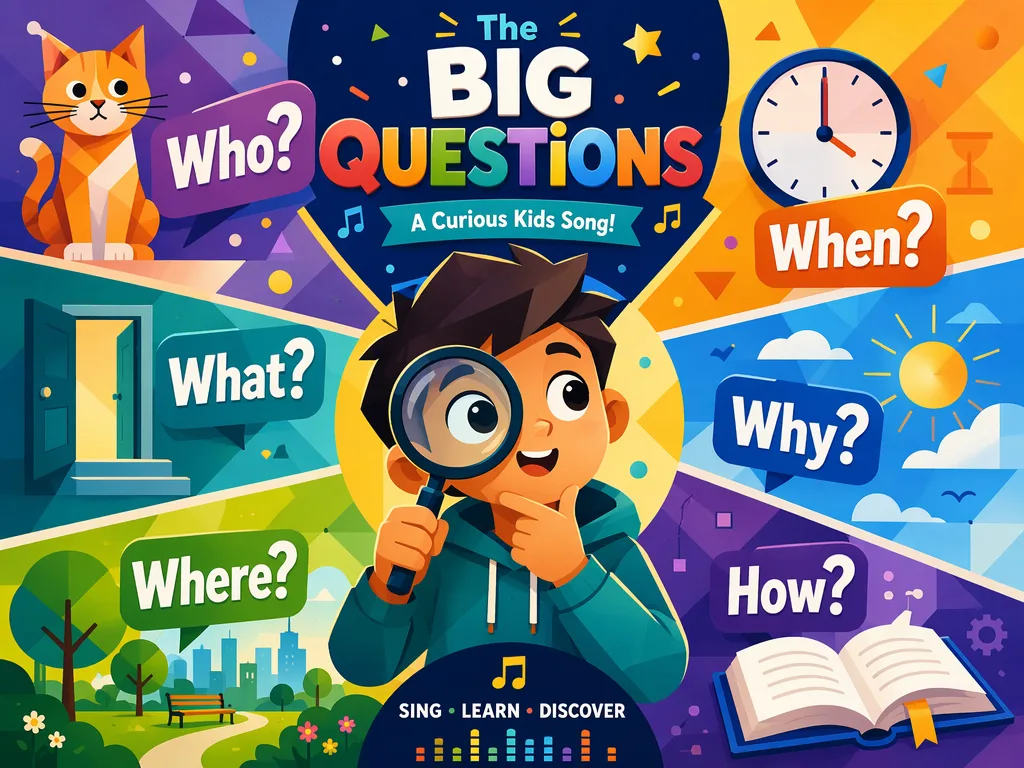
“The Curious Mind (Who, What, Where)” is a cheerful learning song about asking questions. The speaker begins with one question, then admits they have many. The song introduces the six main English question words: who, what, where, when, why, and how.
Each verse gives simple examples:
- Who asks about people.
- What asks about things or names.
- Where asks about places.
- When asks about time.
- Why asks about reasons.
- How asks about methods or ways.
- Actually: used to correct or add more information. “Actually... I have many questions” means “To be more exact, I have many.”
- Fluffy: soft and covered with fur, often used for cats, dogs, pillows, or clouds.
- Knocking on the door: making a sound on a door to ask to enter.
- Clue: information that helps you find an answer.
- Right now: immediately; at this moment.
- Flashlight: a small portable light, especially useful in the dark.
- Take a bow: bend forward after performing; here it adds a fun, theatrical feeling.
- Not a crime: an idiom meaning “it is not wrong.” The song says asking questions is good, not bad.
- Who = a person: “Who is the man?”
- What = a thing, name, or idea: “What is the box?”
- Where = a place: “Where is the park?”
- When = a time: “When is the party?”
- Why = a reason: “Why is the sky blue?”
- How = a way or method: “How do you learn?”
- How = question word
- do = auxiliary verb
- you = subject
- learn = main verb
- “Who is the man?”
- “Where is the station?”
- “When is the party?”
The repeated chorus makes the song easy to remember, which is very helpful for language learners.
Metaphors & Meaning
The song’s main message is that curiosity is positive. Lines like “Asking a question makes you bright” mean that asking questions helps you learn and become smarter. “Bright” can mean “shining,” but here it means intelligent.
“Open your mind” is a common expression. It means to be ready to learn, think, and understand new ideas.
“Tell me the secret, take a bow!” is playful. A “secret” here means the answer or explanation. “Take a bow” is what performers do after a show, so the line makes learning feel like a fun performance.
There are no deep cultural references, but the song uses a familiar classroom style: repetition, examples, and call-and-response energy.
Vocabulary & Slang
Grammar Notes
1. Question words
The song teaches the basic meanings of English question words:2. Word order in questions
English questions often use this pattern:Question word + auxiliary verb + subject + main verb
Example: “How do you learn a new word every day?”
With the verb be, the pattern is simpler:
Question word + be + subject
Examples: